

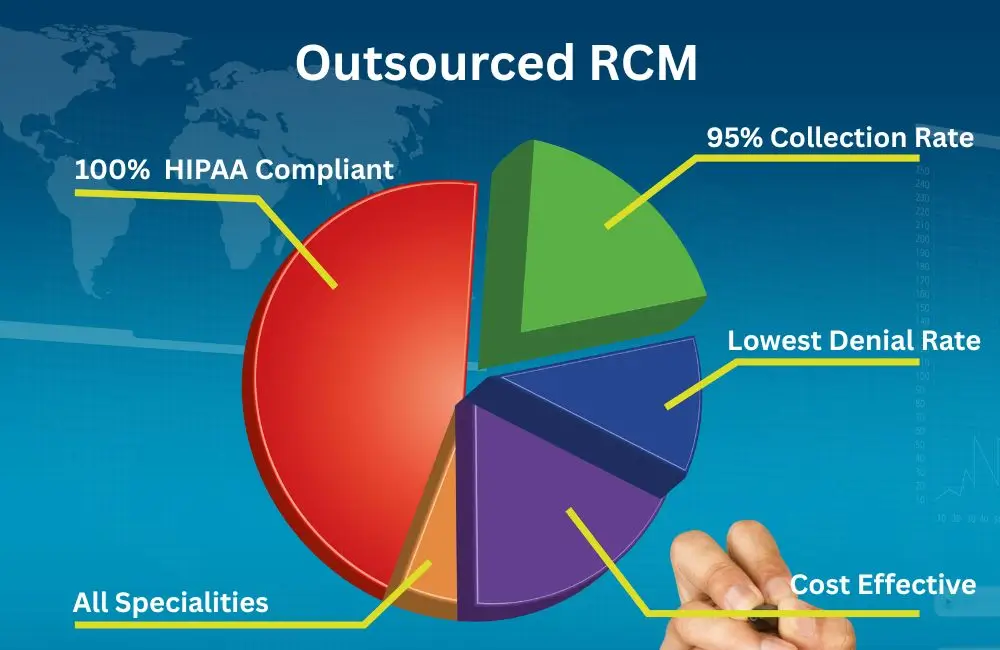
Achieve real revenue growth with Prime Doc Billing’s cost effective, HIPAA Compliant revenue cycle outsourcing solutions to improve the overall financial performance of your healthcare practice.
Our outsourced RCM services include each step from patient scheduling to final payment payout, ensuring seamless claim management, faster reimbursements, and improved financial outcomes for your healthcare practice.
Outsourcing Revenue Cycle Management refers to the process of delegating the financial processes involved in the patient care to a third-party revenue cycle management company. The financial processes include claim billing, denial management, payment posting, and revenue tracking.
The RCM companies provide detailed financial reporting and performance analytics. Healthcare practices get clear insights into denial trends, claim aging, and payer performance that improve overall revenue cycle efficiency of the practice.
Outsourcing Revenue Cycle Management provides healthcare practices with access to automation tools and advanced billing technologies that are quite costly for in-house billing teams. The automation tools and billing technologies include real-time eligibility verification, and automated payment posting to speed up the reimbursement cycle.
Outsourcing Revenue Cycle Management (RCM), overall, creates a structured, transparent, and performance-oriented billing ecosystem to support sustainable revenue growth and operational stability without disrupting the workflow of the practice.
Outsourcing Revenue Cycle Management (RCM) means partnering with an external specialized RCM company to handle the financial and operational processes of the healthcare provider’s billing cycle. Outsourcing RCM either includes handling all administrative and financial tasks or some specialized tasks like denial management or claim scrubbing.
The administrative tasks in the RCM process includes patient scheduling, medical coding, claim submission, denial management, and payment posting. The goal of outsourcing RCM is to reduce administrative workload and increase collection efficiency of the healthcare practice. Outsourcing allows the in-house staff to focus more on clinical work and patient care.
Outsourcing RCM has significantly improved since the past few years compared to the in-house billing operations, particularly because the in-house staff often faces many challenges like high employee turnover, limited specialty expertise, inconsistent denial management, and compliance pressures.
Outsourcing helps the healthcare providers reduce the rate of denied claims and accelerate cash flow of the practice by utilizing external expertise in RCM. The outsourcing expertise leads to financial visibility and stronger revenue consistency for long-term practice growth.
Outsourcing Revenue Cycle Management improves efficiency and financial performance of the practice, but it comes with several operational and compliance challenges like:
• Reduced Operational Control
• Complex Pricing Structure
• Transition and Workflow Disruptions
• Variability in Vendor Performance
• HIPAA Compliance and Data Security Concerns
• Additional or Hidden Charges

Outsourcing Revenue Cycle Management (RCM) process to Prime Doc Billing helps the healthcare providers overcome challenges like increased administrative load and declining financial performance of the practice. Prime Doc Billing overcomes the challenges in Revenue Cycle Management process with:
• Greater Scalability and Flexibility
We scale our RCM services according to the growth of healthcare practices. Prime Doc Billing is a trusted RCM partner that can expand billing operations without requiring major internal hiring, whether a healthcare provider is adding new physicians, expanding to additional locations, or introducing new service lines.
• Reduced Operational Expenses
Outsourcing Revenue Cycle Management to Prime Doc Billing helps omit the costs related to in-house salaries, training, software, employee turnover, and compliance updates. We are an RCM company with a specialized team that already possesses the necessary expertise and software.
• Improved Revenue Recovery Rates
Our professional RCM teams use structured denial management systems, follow-up processes, and payer communication strategies to recover outstanding payments of your healthcare practices.
Software Advice analysis indicates that the in-house revenue recovery collection ranges between 60% -70%, whereas practices with outsourced RCM achieves 85% -95% collection rate.
• Access to Industry-Specific Expertise
Prime Doc Billing maintains teams who are trained in the industry-specific and current CPT coding updates, payer regulations, reimbursement policies, and documentation requirements. The specialized expertise helps the healthcare practices reduce the risk of compliance errors.
• Lower Claim Denial Rates
Our experienced RCM team uses coding reviews, eligibility verification processes, and claim scrubbing tools to identify errors before claim submission. Our front-end prevention of billing issues helps reduce denials, rework and delays in reimbursement.
According to 2024 CMS findings, healthcare practices utilizing specialized RCM services keep denial rates below 5%.
• Accelerated Revenue Collection
Prime Doc Billing follows strict billing timelines and aggressive accounts receivable follow-up procedures. Our faster claim submissions help reduce days in A/R, helping your practices maintain a healthier cash flow.
The 2024 Revenue Cycle Management (RCM) survey highlights that the practices who have shifted to outsourced RCM Models saw improvements in their A/R days by 12 to 18 days.
• Enhanced Regulatory Compliance
We continuously monitor changing billing regulations and payer policies to maintain compliance for your healthcare practice and reduce the risk of audit exposure and regulatory penalties.
Our outsourced RCM services cover every stage of the medical billing cycle under one streamlined workflow. Prime Doc Billing’s end-to-end RCM services include:
♦ Provider Enrollment and Credentialing
♦ Appointment Scheduling Services
♦ Insurance Eligibility Verification
♦ Prior Authorization Services
♦ Revenue Charge Capture
♦ Electronic Claim Processing
♦ Claim Denial Resolution
♦ Payment Reconciliation and Posting
♦ Accounts Receivable Follow-Up
♦ Workers’ Compensation Claims Management
♦ Healthcare Virtual Assistant Services
♦ Payer Contract Analysis
♦ Clearinghouse Management
♦ Telehealth Billing Services
The decision to outsource Revenue Cycle Management is fundamentally about protecting financial performance from the operational weaknesses of in-house billing. Billing accuracy, denial prevention, and compliance management in RCM require the dedicated expertise of outsourced RCM teams as reimbursement systems become more complex and payer scrutiny increases. The growing challenges make it difficult for healthcare providers and their in-house teams to manage these functions effectively internally.
According to Chandawarkar et al, (2024), effective RCM implementation strengthens compliance, reduces billing administration costs and improves patient experience without expanding internal administrative infrastructure. The findings highlight why many healthcare providers are increasingly shifting toward outsourced RCM solutions to improve both operational and financial outcomes.
An outsourced RCM model brings structure, accountability, and specialization into every stage of the revenue cycle. The dedicated teams focus exclusively on reimbursement optimization and accounts receivable performance using standardized workflows, helping healthcare providers reduce revenue leakage and improve overall financial stability.
The following comparison highlights the key financial and operational differences between in-house and outsourced Revenue Cycle Management models.
| In-House RCM | Outsourced RCM | |
|---|---|---|
| Cost per Collection | Higher operational costs due to salaries, software, staffing overhead, and training. | Lower overall collection costs through specialized teams and shared operational infrastructure. |
| Staffing Requirements | In-house billing requires continuous hiring, supervision, and training of billing personnel internally. | Outsourcing reduces internal staffing burden by shifting billing responsibilities to an external RCM team. |
| Technology Infrastructure | Healthcare practices need to independently purchase, maintain, and update billing software and reporting systems. | Specialized billing technology and reporting tools are typically included with the RCM companies’ service models. |
| Claim Denial Rate | Denial rates are often higher because of the lack of denial management resources and updated coding expertise in internal teams. | Denial rates are relatively lower due to specialized claim scrubbing, coding review, and payer-specific billing processes. |
| Accounts Receivable Days | Payment collection often takes a longer time because the follow-up processes are usually delayed or inconsistent. | Outsourcing usually has faster reimbursement cycles through structured claim tracking and aggressive A/R follow-up workflows. |
| Regulatory Compliance | Compliance management depends heavily on internal training and ongoing monitoring capabilities. | Dedicated compliance teams monitor coding updates, regulatory changes, and payer policies continuously. |
| Operational Scalability | Provider volume or expanding services in in-house billing often requires additional hiring and infrastructure investment. | Outsourcing RCM teams easily scale with the healthcare provider’s practice growth without major operational restructuring. |
| Revenue Collection Rate | The revenue collection rates in in-house billing vary depending on the staff expertise and workflow efficiency. | Outsourcing gives higher collection rates achieved through specialized recovery and denial management processes. |

The cost of outsourcing Revenue Cycle Management varies based on the pricing models, size of the practice, service scope and specialty complexity.
Percentage-based collections model is the most common pricing structure of the RCM teams. The Revenue Cycle Management companies charge a percentage of the total revenue collected, which typically ranges from 4% to 8%, depending on complexity and specialty.
The RCM teams in percentage-based models are highly motivated to appeal denials and optimize collections since they only get paid when healthcare practices receive reimbursements.
In the claim-based pricing model, the RCM vendor charges a fixed fee on each claim submitted, which usually varies between $2 and $10 per claim. This model is best used for smaller practices or specialty clinics with highly predictable claim volumes.
The claim-based pricing model provides predictable administrative budgeting and costs, allowing healthcare providers to better forecast revenue cycle expenses.
In the fixed monthly subscription model, the healthcare practices pay a flat monthly fee regardless of claim volume or collections. The cost of monthly subscription ranges from $1000 to $6000 per month, depending on the service scope.
The fixed subscription model provides financial predictability and simplifies budgeting, helping healthcare providers maintain consistent cost planning and avoid fluctuations linked to claim volume or collections.
A hybrid pricing model in the Revenue Cycle Management (RCM) combines multiple pricing structures into one model. The hybrid model includes a flat fee of baseline access and the additional charges for exceeding allowances or sometimes commission.
Hybrid pricing model helps the healthcare providers predict their monthly operational expenses as the baseline subscription remains steady.
Provider-based model is based on the number of active healthcare providers in group practices or larger clinics. Each provider in the healthcare organizations is charged a monthly fee depending on the specialty and workload.
Most RCM vendors also charge a one-time onboarding fee for setup, workflow configuration, system integration, and staff training.
Percentage-based collections model is the most common pricing structure of the RCM teams. The Revenue Cycle Management companies charge a percentage of the total revenue collected, which typically ranges from 4% to 8%, depending on complexity and specialty.
The RCM teams in percentage-based models are highly motivated to appeal denials and optimize collections since they only get paid when healthcare practices receive reimbursements.
In the claim-based pricing model, the RCM vendor charges a fixed fee on each claim submitted, which usually varies between $2 and $10 per claim. This model is best used for smaller practices or specialty clinics with highly predictable claim volumes.
The claim-based pricing model provides predictable administrative budgeting and costs, allowing healthcare providers to better forecast revenue cycle expenses.
In the fixed monthly subscription model, the healthcare practices pay a flat monthly fee regardless of claim volume or collections. The cost of monthly subscription ranges from $1000 to $6000 per month, depending on the service scope.
The fixed subscription model provides financial predictability and simplifies budgeting, helping healthcare providers maintain consistent cost planning and avoid fluctuations linked to claim volume or collections.
A hybrid pricing model in the Revenue Cycle Management (RCM) combines multiple pricing structures into one model. The hybrid model includes a flat fee of baseline access and the additional charges for exceeding allowances or sometimes commission.
Hybrid pricing model helps the healthcare providers predict their monthly operational expenses as the baseline subscription remains steady.
Provider-based model is based on the number of active healthcare providers in group practices or larger clinics. Each provider in the healthcare organizations is charged a monthly fee depending on the specialty and workload.
Most RCM vendors also charge a one-time onboarding fee for setup, workflow configuration, system integration, and staff training.
Yes, outsourced Revenue Cycle Management (RCM) is more cost-effective than maintaining an in-house billing team. Outsourcing reduces expenses related to in-house hiring, salaries, training, benefits, billing software and infrastructure. Outsourcing RCM also minimizes hidden costs like staff turnover, claim rework, and delays in the reimbursement. As a result, healthcare practices often achieve improved cash flow, predictable operational costs, and higher collection efficiency, while allowing in-house teams to focus more on patient care.
According to the MGMA cost benchmarks, outsourced RCM reduces the cost to collect by approximately 40% compared to maintaining an in-house billing operation. While the in-house team struggles with 60% – 70% collection rates, the top performing outsourced partners aim for a net collection rate of 95% or more through optimized workflows and specialized billing teams.
Yes, outsourcing Revenue Cycle Management is generally the right decision, especially when the internal billing teams are not able to keep up with rising administrative complexity, compliance management, sustained revenue optimization and payer requirements. Outsourcing RCM is the right decision for healthcare practices who want to improve the financial predictability and strengthen billing performance without expanding internal infrastructure.
If your practice is operating with A/R days exceeding 40-60 days, outsourcing will help compress the revenue cycle by speeding up improving the speed of claim submission and payer response tracking. This often results in a reduction of 10-20 days or more in Accounts Receivables, improving cash flow stability of your practice.

Outsourcing RCM services becomes important when the internal billing team starts showing inefficiencies that directly impact cash flow of the practice. Following are the indicators highlighting when to outsource Revenue Cycle Management services to the RCM companies:
• Frequent changes in the billing staff leads to inconsistent claim handling and gaps in the follow-up workflows. High staff turnover is when outsourcing becomes essential for healthcare practices.
• When the claim denials begin to rise beyond standard industry benchmarks, it indicates a gap in coding accuracy and payer rule compliance. Outsourcing RCM helps the practice bring denial management expertise and correct the root causes systematically.
• The billing complexity increases significantly when the healthcare practices add new providers and expanded locations. Outsourcing helps provide the infrastructure needed to support expansion without internal staffing burden.
• When the internal and external audits start showing coding inconsistencies and compliance risks, outsourcing helps enforce standardized coding, documentation and compliance workflows.
• When the payment collections decline or remain stable even with the rising patient volume, it often signals billing process inefficiencies. Outsourcing addresses the revenue leakage, delays in claim submission, and unresolved denials to recover the lost revenue of the practice.
Before outsourcing Revenue Cycle Management, it is essential to evaluate how well the RCM specialist aligns with your practice’s financial, operational, and compliance needs.
Service coverage defines the type of responsibilities your RCM partner will handle. Most of the RCM vendors offer end-to-end management while a few provide only specific services like coding, claim scrubbing or denial management. It is important to understand whether a specific RCM company will handle your required services and align with your practice’s existing workflows.
Each medical specialty has unique billing rules, payer expectations, and documentation requirements. The RCM specialist experienced in your specialty is more likely to reduce denials, code accurately, and optimize reimbursements. Without specialty alignment, even the slightest errors affect the revenue performance of the practice.
Beyond specialty focus, the RCM vendors need to have a strong experience in healthcare billing and reimbursement systems. The healthcare expertise includes the understanding of regulatory updates, payer behavior, and constantly updating compliance requirements. Industry experience ensures the adaptation to changing in the billing environment without disrupting the revenue flow.
Since RCM outsourcing involves the handling of sensitive patient health information (PHI), strict data protection measures are essential. The RCM team needs to follow HIPAA compliant processes, use secure systems for data transmission, and maintain internal security for data storage.
Transparent and real-time reporting needs to be a priority for maintaining financial control of the billing process. The healthcare providers should be able to view denial trends, claim status and collection performance at any time. Limited reporting delays important decision-making and reduces financial performance visibility.
Performance standards define the measurable outcomes expected from an outsourced RCM partner. It is important to check whether these standards clearly outline key metrics to ensure accountability and consistent results.
Choosing the right Revenue Cycle Outsourcing company is essential to boost your practice’s cash flow, compliance and long-term financial performance.
• Ensure the company offers end-to-end RCM services or the specific services according to your practice’s needs.
• Choose the RCM specialist that is experienced in your medical specialty to ensure accurate coding and fewer claim errors.
• Confirm HIPAA compliance, data security protocols and healthcare reimbursement processes to ensure safe and efficient billing operations.
• Evaluate performance history of the RCM company, review case studies, KPIs, or benchmarks like denial rates and collection rates to assess reliability.
• Ensure the RCM vendor is able to support your practice as it grows in terms of providers, locations, or patient volume.
Prime Doc Billing is designed to function as a revenue cycle extension for healthcare providers by combining expertise, transparency, and end-to-end operational support.
• We manage the entire revenue cycle from patient scheduling and eligibility verification to claim submissions and denial management, to ensure a seamless and unified workflow.
• Our team consists of certified medical billing and coding experts who ensure every claim is accurately coded based on the clinical documentation. We ensure accuracy in coding to reduce denials, errors, and compliance risks.
• Prime Doc Billing operates under strict HIPAA guidelines with secure data handling, storage protocols and transmissions to protect patient information and maintain regulatory compliance.
• We continuously monitor coding updates, payer policy changes and payer-specific requirements to ensure that your billing processes remain compliant and up-to-date at all times.
• We provide healthcare providers real-time access to key financial metrics including A/R aging, claim status, collection performance and denial trends for complete operational transparency.
• Our pricing structure is straightforward and transparent to ensure there are no hidden charges for standard billing processes, reporting and claim management.
• Our team brings specialized knowledge across various medical fields, making us adapt to the billing strategies of each specialty.
• We conduct a detailed free analysis of your current billing performance before onboarding. We identify revenue gaps, denial patterns, and operational inefficiencies to help optimize your revenue cycle from the start.
• Prime Doc Billing operates as a strategic RCM partner to focus on long-term financial improvement and scalable growth for your practice.
Get Started Today
Join hundreds of healthcare providers who have transformed their practice with our Outsourced RCM services in USA.
Let our medical billing experts review your revenue cycle and uncover hidden revenue opportunities.
Let our medical billing experts review your revenue cycle and uncover hidden revenue opportunities.

 (347) 650-2656
 (347) 650-2656
 info@primedocbilling.com


