


Prime Doc Billing provides Medical Credentialing Services for healthcare providers across all 50 U.S. states. Our credentialing specialists manage provider credentialing, payer enrollment, CAQH maintenance, Medicare and Medicaid enrollment, and PECOS registration to streamline provider onboarding.
By maintaining accurate provider records and managing recredentialing requirements, we help practices avoid billing disruptions, maintain compliance, and support a healthy healthcare revenue cycle through uninterrupted payer participation and reimbursement readiness.

Prime Doc Billing’s credentialing services cover every component of the provider credentialing process. From initial verification to ongoing payer maintenance, our team manages the entire credentialing workflow so you never miss a deadline or lose revenue due to a lapsed credential.
Provider credentialing services involve verifying a provider’s education, training, licensure, certifications, and work history against primary sources. Our credentialing specialists collect and verify all required documentation, submit applications to payers, and follow up until each credentialing file is approved. Accurate provider credentialing is the foundation of a clean revenue cycle and ensures your providers receive reimbursements without interruption.
Provider enrollment is the process of formally registering a credentialed provider with insurance payers to participate in their networks. Prime Doc Billing handles provider enrollment with Medicare, Medicaid, and commercial payers including group practice enrollments. Timely provider enrollment ensures your providers are active in payer systems so claims are accepted and reimbursements are processed without delay.
Payers require providers to undergo recredentialing periodically, typically every two to three years, to confirm their credentials remain current and compliant. Prime Doc Billing tracks all recredentialing deadlines and manages renewals proactively before expiration. Staying ahead of recredentialing timelines prevents payer termination and protects your practice from revenue disruptions caused by lapsed credentials.
Hospital privileges allow providers to practice within a hospital setting and must be applied for and approved separately from payer credentialing. Prime Doc Billing manages hospital privilege applications, documentation collection, and follow-ups with hospital credentialing committees. Securing hospital privileges expands the scope of practice for providers and enables them to bill for services delivered across inpatient and outpatient hospital settings.
A National Provider Identifier (NPI) is a mandatory 10-digit identifier required for all healthcare providers billing insurance. Prime Doc Billing handles both Type I NPI registration for individual providers and Type II NPI registration for group practices or organizations. Accurate NPI registration is required before any payer enrollment or claim submission can take place.
The Council for Affordable Quality Healthcare (CAQH) ProView database centralizes provider credentialing information used by hundreds of commercial payers. Prime Doc Billing creates and maintains CAQH profiles on your behalf, keeping attestations current and data updated. An up-to-date CAQH profile accelerates the commercial insurance credentialing process and reduces back-and-forth with individual payers.
The Provider Enrollment, Chain and Ownership System (PECOS) is Medicare’s online enrollment management system. Prime Doc Billing manages PECOS enrollment, updates, and revalidations for providers and group practices. Accurate PECOS maintenance ensures uninterrupted Medicare billing privileges and keeps provider records current in the CMS system.
Credentialing applications involve multiple payers, timelines, and documentation requirements running simultaneously. Prime Doc Billing provides real-time application tracking so you always know the status of each credentialing file. Our team monitors pending applications, responds to payer information requests, and escalates delays to keep credentialing timelines on track.
Prime Doc Billing provides comprehensive insurance credentialing services that cover both government programs and commercial payers. Our end-to-end approach ensures every provider is enrolled across all relevant payer networks so your practice maximizes its reimbursement potential from day one.
Government payer enrollment requires strict adherence to CMS rules, documentation standards, and enrollment timelines. Prime Doc Billing handles all government program enrollments with accuracy and compliance so your providers can serve Medicare and Medicaid beneficiaries without billing disruptions.
Medicare enrollment through PECOS establishes a provider’s eligibility to bill for services rendered to Medicare beneficiaries. Prime Doc Billing manages the full Medicare enrollment process including application preparation, PECOS submission, revalidation tracking, and resolution of enrollment issues. Timely Medicare enrollment protects your practice from billing gaps and ensures reimbursements flow without interruption.
Medicaid enrollment requirements vary by state and involve separate applications for each state’s Medicaid program where a provider practices. Prime Doc Billing manages state-specific Medicaid enrollment processes, documentation, and follow-ups to ensure your providers are active participants in each relevant state Medicaid network. Accurate Medicaid enrollment prevents claim rejections and supports consistent reimbursements for services delivered to Medicaid patients.
Durable Medical Equipment, Prosthetics, Orthotics, and Supplies (DMEPOS) enrollment involves specialized CMS requirements for suppliers providing equipment and supplies to Medicare beneficiaries. Prime Doc Billing manages DMEPOS enrollment including surety bond compliance, accreditation coordination, and CMS application submission. Proper DMEPOS enrollment ensures your practice receives accurate reimbursements for covered equipment and supplies.
Commercial insurance credentialing connects your providers to major private payer networks including Blue Cross Blue Shield, Aetna, Cigna, UnitedHealthcare, and Humana. Prime Doc Billing manages credentialing applications, contract reviews, and follow-ups across all major commercial payers. Being credentialed with the right commercial payers expands your patient base and ensures timely, accurate reimbursements for services rendered to privately insured patients.
Different provider types face unique credentialing challenges based on their specialty, setting, and payer mix. Prime Doc Billing provides customized credentialing services for a wide range of provider types to ensure every credentialing application meets the specific requirements of each payer and specialty.
Dental credentialing involves verifying dental licenses, DEA certificates, and specialty training before enrolling dentists with dental and medical insurance plans. Prime Doc Billing manages dental credentialing and enrollment with Delta Dental, Cigna Dental, Aetna Dental, and other major dental payers. Accurate dental credentialing ensures dental providers receive timely reimbursements for both preventive and specialty dental services.
Behavioral health credentialing involves specific documentation requirements for mental health professionals including licensed clinical social workers, psychologists, psychiatrists, and licensed professional counselors. Prime Doc Billing manages behavioral health credentialing with major payers and state Medicaid programs while maintaining strict confidentiality. Timely behavioral health credentialing reduces the administrative burden on mental health providers so they can focus on delivering uninterrupted patient care.
Physical therapy credentialing requires verifying state licensure, clinical certifications, and liability insurance before enrollment with payers. Prime Doc Billing manages physical therapy credentialing and payer enrollment across Medicare, Medicaid, and commercial plans. Proper credentialing for physical therapists ensures clean claim submissions and reduces the risk of denials related to provider eligibility.
Nurse practitioner (NP) credentialing involves verifying advanced practice nursing licenses, DEA registrations, and collaborative practice agreements where required by state law. Prime Doc Billing manages NP credentialing and enrollment with Medicare, Medicaid, and commercial payers. Our credentialing specialists understand the state-specific scope-of-practice rules that affect NP enrollment timelines and requirements.
Hospital credentialing involves verifying provider qualifications and granting privileges to practice within a hospital’s clinical environment. Prime Doc Billing coordinates with hospital credentialing committees to submit complete and accurate applications on behalf of your providers. Timely hospital credentialing expands a provider’s ability to bill for inpatient and facility-based services while maintaining compliance with accreditation standards.
Telemedicine credentialing requires payer enrollment across multiple states where a provider delivers virtual care services. Prime Doc Billing manages telehealth payer credentialing across state lines including state licensure verification and payer-specific telehealth enrollment requirements. Proper telemedicine credentialing ensures your virtual care providers receive reimbursements for telehealth services without compliance gaps.
Prime Doc Billing provides scalable credentialing solutions for every type of healthcare provider and practice. Whether you are onboarding a single provider or managing credentialing for a large group practice, our team adapts to your volume and requirements without operational bottlenecks.
Solo practitioners and independent providers face the credentialing process without an administrative team to support them. Prime Doc Billing provides dedicated credentialing support to individual providers, managing every step from CAQH setup to payer enrollment. Our goal is to get solo providers credentialed and billing as quickly as possible so they can focus entirely on patient care.
Group practices manage credentialing for multiple providers across different specialties and payer networks simultaneously. Prime Doc Billing centralizes credentialing management for group practices to ensure consistent timelines, organized documentation, and accurate payer enrollment for every provider in the group. Our team keeps every credentialing file current so your group practice maintains uninterrupted billing across all payers.
Hospital systems require credentialing management at scale, covering providers across multiple departments, locations, and payer contracts. Prime Doc Billing provides hospital-focused credentialing services to streamline provider onboarding, manage privilege applications, and ensure compliance with NCQA and accreditation standards. Our credentialing specialists protect the revenue integrity of hospital systems by keeping every provider’s credentials active and accurate.
Prime Doc Billing partners with other medical billing companies as a reliable back-office credentialing partner. We handle provider credentialing, enrollment, and recredentialing on behalf of billing companies so they can serve their clients without building an internal credentialing department. Our team maintains service quality and confidentiality to help billing companies meet client expectations at scale.
Hospital credentialing involves verifying provider qualifications and granting privileges to practice within a hospital’s clinical environment. Prime Doc Billing coordinates with hospital credentialing committees to submit complete and accurate applications on behalf of your providers. Timely hospital credentialing expands a provider’s ability to bill for inpatient and facility-based services while maintaining compliance with accreditation standards.
Telemedicine credentialing requires payer enrollment across multiple states where a provider delivers virtual care services. Prime Doc Billing manages telehealth payer credentialing across state lines including state licensure verification and payer-specific telehealth enrollment requirements. Proper telemedicine credentialing ensures your virtual care providers receive reimbursements for telehealth services without compliance gaps.
Because we deliver accurate, compliant, and specialty-focused credentialing solutions that protect your revenue and accelerate provider onboarding. Prime Doc Billing’s credentialing team brings deep expertise in payer requirements, state-specific rules, and enrollment timelines to every credentialing file we manage.

Prime Doc Billing follows a structured, step-by-step credentialing process to ensure accurate applications, timely submissions, and successful payer enrollments for every provider.
The first step of our credentialing process is gathering all required provider information and documentation. This includes medical licenses, DEA certificates, malpractice insurance, board certifications, education and training records, and work history. Complete documentation at intake prevents delays and information requests from payers later in the credentialing process.
Our credentialing specialists create or update the provider’s CAQH ProView profile with accurate and complete information. We keep the CAQH profile current with regular attestations and data updates throughout the credentialing process. A verified and up-to-date CAQH profile accelerates enrollment with the commercial payers that use CAQH as their primary source of provider data.
Primary source verification confirms the authenticity of a provider’s credentials directly with the issuing organizations. Our team verifies medical licenses with state boards, certifications with issuing bodies, and education records with training institutions. Accurate primary source verification is the foundation of a compliant credentialing file and protects your practice from audit risks.
Our credentialing specialists prepare complete and accurate applications for each payer, tailored to their specific requirements and formats. We submit applications to Medicare, Medicaid, and commercial payers with all required supporting documentation. Thorough application preparation at this stage reduces the risk of payer information requests and speeds up the approval timeline.
After submission, our team actively monitors the status of each application and responds to payer information requests promptly. We escalate delays, resolve discrepancies, and maintain communication with payer credentialing departments throughout the review process. Proactive follow-up is critical to keeping credentialing timelines on track and preventing unnecessary delays in provider enrollment.
Once a payer approves the credentialing application, our team confirms the provider’s effective date of participation and updates our tracking records. We communicate enrollment confirmations and effective dates to your practice so billing can begin on time. Tracking effective dates accurately prevents claims from being submitted before a provider is active in the payer system.
Credentialing is not a one-time event. Prime Doc Billing monitors all expiration dates, revalidation requirements, and recredentialing timelines on an ongoing basis. Our team manages renewals proactively to ensure your providers maintain active status with every payer and never experience billing interruptions due to expired credentials.
Frequently Asked Questions
Medical credentialing is the process of verifying a healthcare provider’s qualifications, including their education, training, licensure, certifications, and work history, against primary sources. Payers and hospitals require credentialing to confirm that a provider meets their standards before authorizing them to deliver and bill for services within their network.
The cost of medical credentialing services varies based on the number of providers, payers, and the scope of services required. Most credentialing service providers charge either a flat fee per provider per payer or a monthly retainer. Prime Doc Billing offers competitive and transparent credentialing pricing tailored to your practice’s size and needs. Contact us for a customized quote.
A credentialing specialist manages the entire provider credentialing workflow on behalf of a healthcare practice. Their responsibilities include collecting provider documentation, verifying credentials against primary sources, setting up and maintaining CAQH profiles, submitting enrollment applications to payers, tracking application statuses, and managing recredentialing timelines. A credentialing specialist ensures that providers are enrolled accurately and on time to maintain uninterrupted billing.
The credentialing process typically takes between 60 and 120 days depending on the payer and provider type. Government payer enrollments with Medicare and Medicaid often take 90 to 120 days, while commercial payer credentialing may take 60 to 90 days. The timeline can vary based on application completeness, payer processing times, and how quickly primary source verifications are completed.
Nurse practitioner credentialing typically takes 60 to 120 days depending on the state, payer, and whether collaborative practice agreements are required. States with stricter scope-of-practice requirements may add additional steps to the NP credentialing timeline. Prime Doc Billing manages all NP-specific credentialing requirements to keep the process as efficient as possible.
A provider who is already licensed in a state may still require 60 to 90 days for payer credentialing and enrollment. Having an active state license accelerates the primary source verification step, but payer-specific review timelines, CAQH attestation, and enrollment processing still apply. Prime Doc Billing manages these steps efficiently to reduce the overall timeline wherever possible.
Credentialing with Blue Cross Blue Shield (BCBS) typically takes 60 to 120 days depending on the state plan involved, as BCBS operates independently across different states. Each state plan has its own credentialing committee and processing timeline. Prime Doc Billing monitors BCBS credentialing applications closely and follows up proactively to prevent unnecessary delays.
Medicaid credentialing timelines vary by state and typically range from 60 to 120 days. Some state Medicaid programs have backlog periods that may extend processing times further. Prime Doc Billing manages state-specific Medicaid enrollment applications and follows up with state agencies to keep timelines on track.
Medicare enrollment through PECOS generally takes 60 to 90 days for standard provider enrollment applications. New providers, reassignments, and organizational enrollments may have different processing timelines. Prime Doc Billing submits complete Medicare applications and monitors PECOS status to ensure accurate and timely Medicare enrollment for every provider.
The main types of credentialing in healthcare include provider credentialing with insurance payers, hospital credentialing and privileging, government program enrollment (Medicare, Medicaid, DMEPOS), and facility or organization credentialing. Each type serves a different purpose in verifying a provider’s qualifications and authorizing them to deliver and bill for services in a specific setting or network.
Credentialing is the initial process of verifying a provider’s qualifications and enrolling them with payers or hospitals for the first time. Recredentialing is the periodic renewal of that verification, typically required every two to three years by payers and accreditation organizations. Both processes involve verifying credentials against primary sources, but recredentialing also reviews any changes in a provider’s practice history, malpractice claims, or licensure status since their last credentialing cycle.
Credentialing is the process of verifying a provider’s qualifications and determining their eligibility to participate in a payer network. Enrollment is the administrative step that follows credentialing, where the provider is formally registered in the payer’s system and assigned a provider number for billing purposes. Credentialing must be completed and approved before enrollment can be finalized.
Credentialing is the process of verifying a provider’s qualifications for participation in payer networks or hospital systems. Hospital privileging is a separate and additional process that grants a credentialed provider specific clinical permissions to perform defined procedures and services within a hospital’s facilities. A provider must be credentialed before privileges are granted, but credentialing alone does not automatically authorize hospital practice.
Best practices for provider credentialing and enrollment include maintaining up-to-date CAQH profiles with regular attestations, collecting complete documentation before submitting any applications, tracking all credentialing and recredentialing deadlines proactively, submitting payer applications as early as possible to account for processing timelines, and following up consistently with payers to resolve pending items quickly. Partnering with an experienced credentialing services provider like Prime Doc Billing ensures all best practices are followed consistently across every provider and payer.
Many practices debate whether to manage credentialing internally or outsource to a specialist. Here is a direct comparison to help you make the right decision for your practice.
| Credentialing | Enrollment / Privileging | |
|---|---|---|
| Definition | Verification of a provider's qualifications, licenses, and training against primary sources. |
Enrollment: Formal registration with a payer for billing. Privileging: Authorization to practice within a hospital. |
| When It Occurs | Before enrollment or privileging can begin. | After credentialing is approved by the payer or hospital. |
| Purpose | Confirm provider meets quality and compliance standards. | Authorize billing or hospital practice rights. |
| Managed By | Insurance payers, hospitals, credentialing organizations. | Payers (enrollment) or hospital medical staff offices (privileging). |
Many practices debate whether to manage credentialing internally or outsource to a specialist. Here is a direct comparison to help you make the right decision for your practice.
| In-House Credentialing | Outsourced Credentialing Services | |
|---|---|---|
| Staffing | Requires dedicated credentialing staff, hiring, and ongoing training. | Immediate access to experienced credentialing specialists with no hiring overhead. |
| Cost | High fixed costs including salaries, benefits, and credentialing software. | Predictable and scalable pricing based on provider volume and service scope. |
| Expertise | Dependent on the knowledge level of in-house staff; turnover creates gaps. | Deep payer-specific expertise maintained across all credentialing files. |
| Scalability | Limited by internal staff capacity; hard to scale for new provider onboarding. | Scales seamlessly with practice growth and provider volume changes. |
| Deadline Tracking | Risk of missed deadlines without dedicated tracking systems. | Proactive monitoring of all recredentialing and revalidation timelines. |
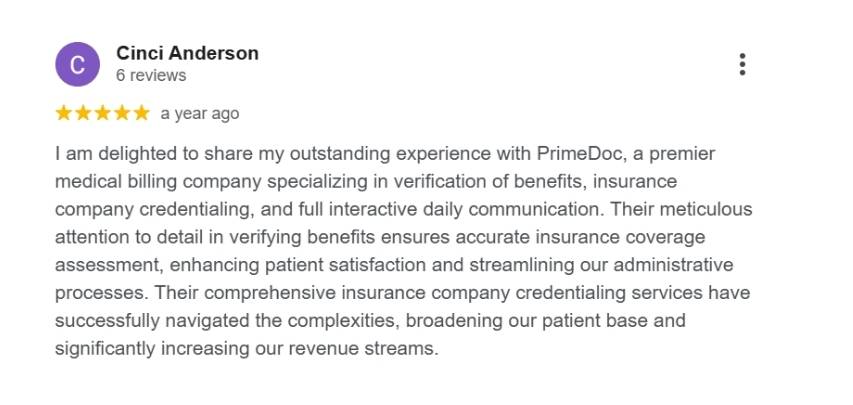
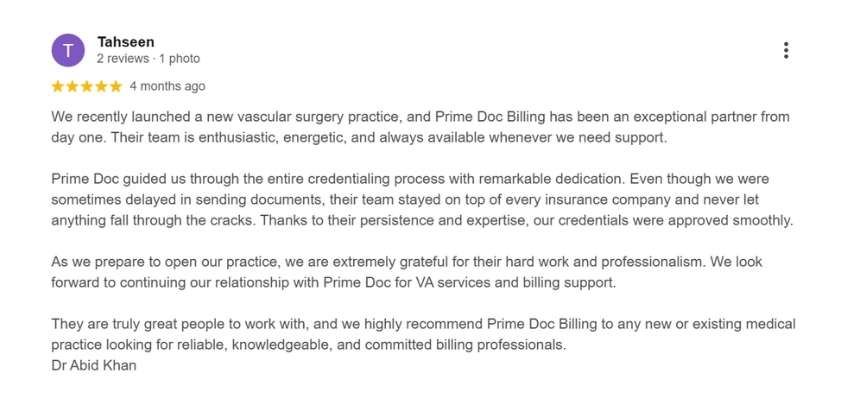
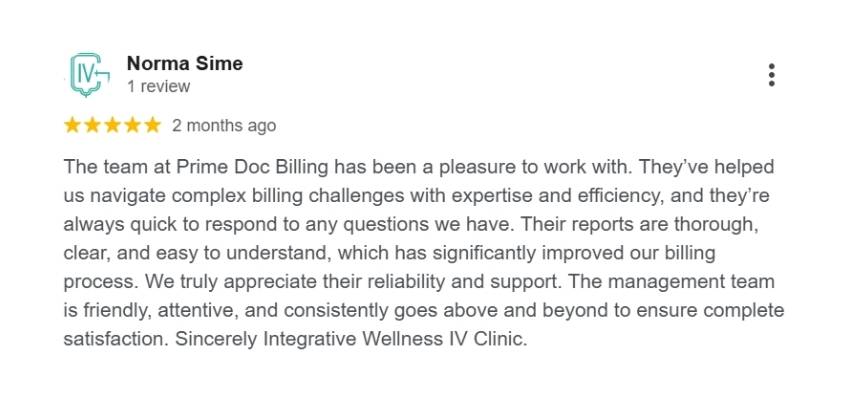
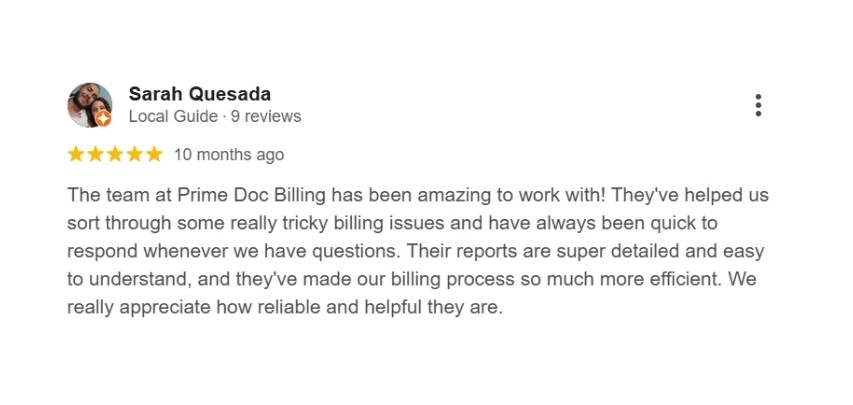
What Healthcare Providers Say About Us?


Get Started with Prime Doc Billing's Medical Credentialing Services Today
Do not let credentialing delays hold your providers back from billing and earning their rightful reimbursements. Prime Doc Billing's medical credentialing specialists manage every step of the process with accuracy, compliance, and speed so your practice maintains uninterrupted revenue. Partner with Prime Doc Billing to experience faster provider onboarding, cleaner payer enrollments, and proactive credentialing management that protects your practice's financial health.
Get In Touch
Why Practices Trust Us
Let our medical billing experts review your revenue cycle and uncover hidden revenue opportunities.
Let our medical billing experts review your revenue cycle and uncover hidden revenue opportunities.

 (347) 650-2656
 (347) 650-2656
 info@primedocbilling.com


