(347) 650-2656
 (347) 650-2656
 info@primedocbilling.com


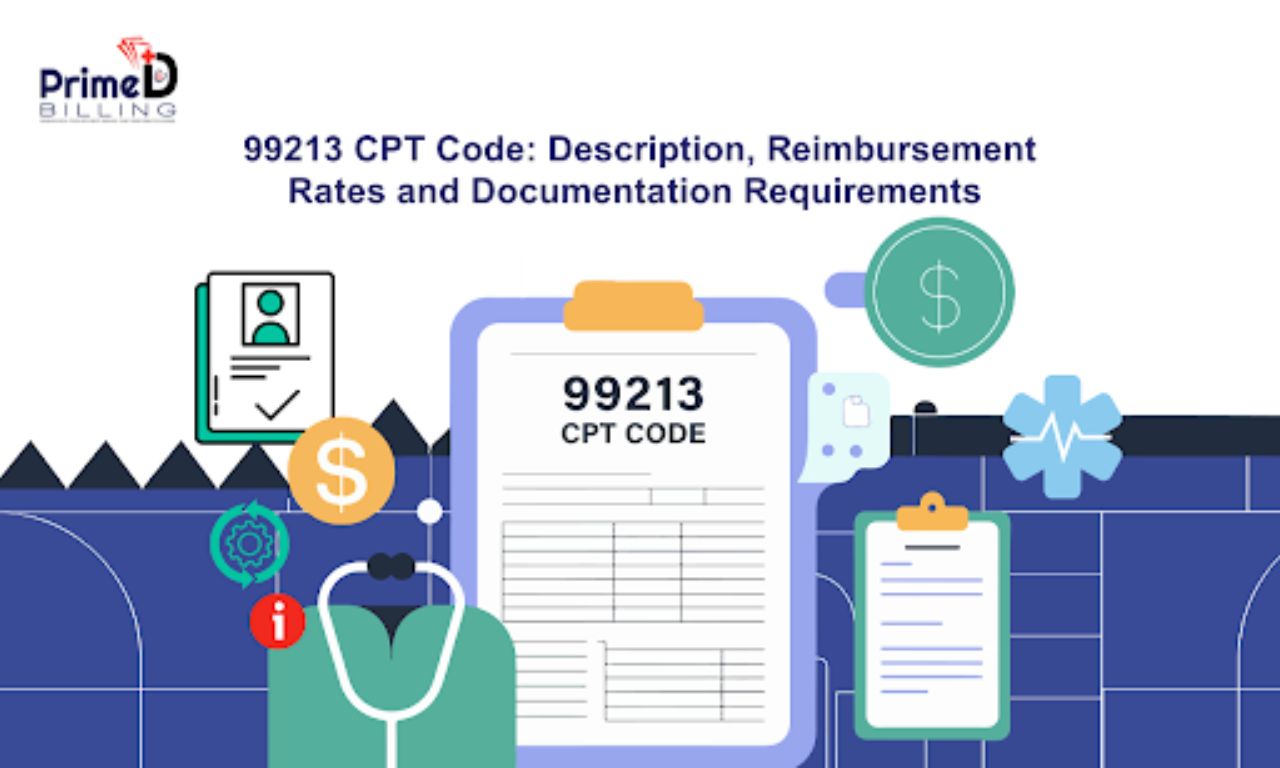
Table of Contents
▼99213 CPT Code: Description, Reimbursement Rates and Documentation Requirements
CPT Code 99213 is an Evaluation and Management (E/M) service used for outpatient or office visits involving established patients with low-complexity Medical Decision Making. CPT 99213 is typically reported when the patient comes with a stable condition or a minor health issue.
99213 CPT reimbursement rates vary depending on the payer type and settings. Under Medicare, the average reimbursement rate typically ranges from $90 – $100 in a non-facility setting, whereas the facility payments are comparatively lower. Commercial insurers reimburse at a higher rate, ranging from $110 – $160 and sometimes even more. Medicaid pays the lowest rate, commonly between $40 – $80 per visit. To support these reimbursements, proper documentation is required to justify the level of medical services provided.
Proper documentation requirements for CPT 99213 supports either low-complexity MDM or time-based billing for a clean claim submission. 99213 documentation clearly includes patient’s history, relevant examination funding, condition assessment, and a management plan. Healthcare providers also provide medical necessity for prescribed medications and follow-up instructions for accurate 99213 CPT coding. Insufficient documentation leads to claim denial or audits.
What is CPT Code 99213?
CPT code 99213 is an Evaluation and Management code used to report established patients’ outpatient visits for low-complexity Medical Decision Making (MDM). CPT 99213 is typically applied when the patient’s condition is either stable or involves a minor clinical issue that requires limited data review.
CPT 99213 is usually selected based on the total provider time, which ranges from 20 to 29 minutes. This CPT 99213 timeframe includes all physician activities like patient evaluation, counseling, documentation, chart review, and coordination of care. Proper use of CPT 99213 depends on meeting the criteria of either MDM or 20-29 minutes time requirements as defined in the E/M guidelines.
When to use CPT Code 99213?
CPT code 99213 is only to be used when an established patient (seen by the provider within the last 3 years) is consulted for a low-complexity (low-level Medical Decision Making- MDM) problem that requires minimal to moderate amount of clinical work.
Which Medical Conditions Commonly Qualify for CPT 99213?
The most common medical conditions that qualify for CPT code 99213 are:
- Stable Chronic Disease Management
- Acute, Uncomplicated Illnesses
- Minor Injuries
- Orthopedic Issues
- Behavioral Health and Medication Follow-Ups
- Preventive-Adjacent Visits
What are the Common Denials associated with 99213?
Some of the most common denials associated with CPT code 99213 are:
1. Incomplete Documentation
The error related to incomplete documentation in CPT 99213 occurs when the medical note is missing key elements like treatment plan, clinical reasoning, or clear diagnosis. The insurance payer is unable to justify medical necessity in this case.
2. Unsupported Time Documentation
The unsupported time documentation related denial occurs when the medical billing is based on time but either the total time is not documented or time elements like counseling or review are not specified. The CPT 99213 related denial also occurs when the time is outside the 20-29 minutes timeframe.
3. Lack of Medical Necessity
The 99213 denial occurs when the medical visit is either not clinically justified or too vague. The documentation often lacks evaluation, decision-making, or active management of a condition.
4. Duplicate Claim Billing
Duplicate claim billing happens when the same service is billed twice without correction. The overlapping of E/M (Evaluation and Management) claims on the same date results in automatic denials.
5. Wrong Patient Classification
The kind of denial occurs when the patient is new but is billed as the established one. The inability to follow the 3-year rule of established vs new patients results in claim denials.
6. Missing or Inappropriate Modifier 25
The denials related to missing or inappropriate modifier 25 happens when the E/M visit is billed with a procedure but either no -25 modifier is used or incorrect modifier is placed without a separate identifiable service.
7. Upcoding (99212 vs 99213)
The upcoding denial in 99213 occurs when the medical visit documentation supports 99212 (very low complexity) but is billed under 99213 instead. The kind of error results in either downcoding to 99212 or claim denial if the insurance payer identifies an overcoding pattern.
What are the Common Mistakes to avoid while using 99213?
Avoiding the following mistakes while using CPT code 99213 leads to clean claim billing and submission.
1. Coding and Compliance Errors
Verifying the visit to see if it actually meets low-level MDM criteria and double-checking the patient status (established vs new) using the 3-year rule helps avoid compliance errors while using 99213 CPT code.
2. Mistakes in Time-Based Billing
Always ensure the doctor-patient encounter time falls within 20-29 minutes by documenting the total provider time while using 99213 CPT. Using a time statement template in the EMR (Electronic Medical Record) helps avoid mistakes in the time-based medical billing.
3. Telehealth Documentation Issues
Specifying the mode of visit (audio / video) and recording the patient and provider location in the medical claim before using 99213 CPT code helps avoid telehealth documentation issues.
4. Insufficient Documentation
Clearly document the patient’s complaint, doctor’s assessment and treatment plan to avoid vague terms without explanation. Following the problem + status + plan rule creates the audit-proof medical documentation for claim submission.
5. Errors in Medical Decision Making (MDM)
The medical documentation needs to support essential MDM elements like problem complexity, data reviewed and risk level to avoid errors in Medical Decision Making while using CPT code 99213.
How Does CPT 99213 Affect Revenue Cycle Management?
CPT 99213 affects healthcare Revenue Cycle Management in the following ways:
1. Improving Coding Accuracy and KPIs
Accurate use of 99213 directly improves Key Performance Indicators (KPIs) including higher first-pass claim acceptance rates, lower denials, and better net revenue collection rate.
2. Preventing Revenue Cycle Pitfalls
Frequent use of 99213 CPT code lowers the ratio of repeated mistakes, which leads to lesser rework and resubmissions. Accuracy in 99213 coding generates cleaner RCM workflows, leading to faster claim processing.
3. Driving Revenue Generation and Value
99213 CPT coding contributes significantly to outpatient revenue due to its high volume. Accurate 99213 coding leads to full and legitimate revenue capture in the RCM process of a healthcare practice.
4. Affecting Denials and Compliance
Because of the frequent use of 99213 CPT code, the insurance payers keep it as a top target for reviews and audits. Proper handling of 99213 reduces claim denials and protects the claim against compliance issues and audit risks in the RCM process.
5. Influencing High-Volume Accounts Receivable
A very large portion of the Accounts Receivables often consists of the 99213 claims. Cleaner 99213 claim leads to faster reimbursements and directly impacts cash flow speed and stability.
What are the Documentation Requirements for CPT 99213?
CPT 99213 documentation is essential for ensuring proper reimbursement, compliance and accurate reflection of the clinical work performed during an established patient encounter. Following documentations are required for the accurate CPT 99213 processing:
1. Medical Decision Making (MDM)
Medical billing claim documentation is required to show low complexity Medical Decision Making (MDM) by:
- Addressing the patient’s condition as either a stable chronic condition or acute uncomplicated illness.
- Including evidence of the lab or test review, ordering basic diagnostic tests or reviewing external test records.
- Showing low-risk like routine prescription management, OTC medication, or minimal intervention.
2. Time-Based Billing
99213 is also supported by the total time on the date of service which is limited to 20-29 minutes of provider and patient encounter. The 99213 CPT code documentation is required to include total provider time, and activities performed in the timeframe, like counseling and chart review.
3. Required Clinical Documentation Elements
In addition to MDM and time, the 99213 documentations include:
- Chief complaint (patient’s presenting problem)
- History (relevant clinical update)
- Assessment (diagnosis with condition status)
- Plan (treatment decisions including labs, meds, and follow-up)
- Medical necessity (hospital visit justification)
What Type of Medical Decision-Making (MDM) Is Required for 99213?
Low complexity Medical Decision Making (MDM) is required for CPT code 99213. Low-complexity MDM means the clinical judgement needs to reflect simple or stable conditions with minimal data review and low-risk management decisions.
What Are the Reimbursement Rates for CPT Code 99213?
Reimbursement rates for CPT 99213 are standardized across the US for low-complexity established patient visits. Payments are also adjusted using Geographic Practice Cost Index (GPCI) so the actual rates vary by service location.
1. Medicare Reimbursement Rates
Medicare provides a standard benchmark for the reimbursement rates of CPT code 99213. The typical non-facility (office setting) Medicare reimbursement rate is around $90 – $100, while in facility settings (hospitals, or outpatient departments), the reimbursement is generally lower, around $60 – $70.
2. Commercial Insurer Reimbursement Rates
Private insurance companies usually reimburse higher than the Medicare, however the providers are required to adhere to negotiated contract terms and conditions. The reimbursement rates for commercial insurers range from $110 – $160 or above per visit. The commercial insurer rates are sometimes 150% – 170% higher of Medicare rates.
3. Medicaid Reimbursement Rates
Medicaid generally reimburses with the lowest rates, typically ranging from $40 – $80 per visit. The medicaid reimbursement rates vary significantly by state as each Medicaid program sets their own fee schedule and policies.
What are the Factors that affect 99213 CPT code reimbursement?
Some of the most common factors that affect 99213 CPT code reimbursements are:
1. Medicare Physician Fee Schedule (PFS) Updates
Medicare revises the Physician Fee Schedule (PFS) annually, which either increases or decreases the allowed payment amount for healthcare providers.
2. Practice Setting
Reimbursement rates for 99213 CPT differs depending on whether the service was provided in a private office (non-facility) or in a hospital setting (facility).
3. Geographic Service Location
Geographic location impacts the CPT 99213 payment rates due to the difference in living and practice expenses. CPT 99213 reimbursements, in this case, are adjusted using regional factors.
4. Clinical Documentation and Coding Accuracy
Accuracy in clinical documentation and medical coding are essential to support medical necessity and justify the level of service for CPT code 99213.
5. Payer Type
Different payers have their own fee schedule and contract agreements, like Medicare, Medicaid and commercial insurers. Separate payer fee schedules result in the varying reimbursement amounts for the same 99213 CPT code.
What Is the RVU of CPT Code 99213?
The total RVU (Relative Value Unit) for CPT code 99213 (low-complexity established patient visit) in 2026 is approximately 2.75 in a non-facility setting. The total RVU is calculated as a result of three components as per CMS standard, which are Work RVU (wRVU), Practice Expense RVU (PE RVU), and Malpractice RVU (MP RVU).
The RVU for 99213 varies slightly by year and setting since it is updated annually under the Medicare Physician Fee Schedule and adjusted based on the location where the medical services are performed.
The practice expense portion differs between the facility and non-facility setting because of the overhead costs of equipment, staffing and supplies. As a result, Practice Expense (PE) RVU in a non-facility setting is typically higher, approximately 1.35 to cover the overhead costs. In contrast, in a facility setting (hospital outpatient department or ambulatory surgical center), the overhead costs are covered by the facility, leading to a slightly lower PE RVU, around 1.30.
Can CPT 99213 be billed for telehealth?
Yes, CPT 99213 can be billed for telehealth visits when the service is provided to an established patient and conducted via audio-video platform. In some cases, the payer allows the 99213 telehealth consultation via audio-only platform.
Can CPT 99213 be billed for urgent care?
Yes, CPT 99213 can be billed for urgent care for established patients. CPT 99213 is a frequently used (E/M) code in urgent care billing.
What Are the Billing Guidelines for CPT Code 99213?
CPT 99213 is billed for established patient office visits with low-complexity evaluation and management services. 99213 billing either follows MDM guidelines or total time based reporting, depending on the documentation of the patient visit.
What is the Difference between 99213 and 99214?
99213 |
99214 |
|
| Usage | CPT code 99213 is used for established patient visits that involve low-complexity medical decision-making. | CPT 99214 code represents established outpatient visits that involve moderate to complex medical decision-making. |
| Time | CPT 99213 reflects a total time range of 20-29 minutes. | CPT 99214 reflects a higher time range of 30-39 minutes. |
| Work Involved | CPT 99213 code involves a lower level of clinical work, like simple evaluation, limited data review, and routine management. | CPT 99214 coding involved a higher level of clinical work with detailed assessment, increased data analysis and complex medical decision making (MDM). |
Partner with Prime Doc Billing Today
Let our experts handle your billing — streamline your revenue cycle and focus on patient care.