(347) 650-2656
 (347) 650-2656
 info@primedocbilling.com



What Are the Main Steps of the Medical Billing Process?
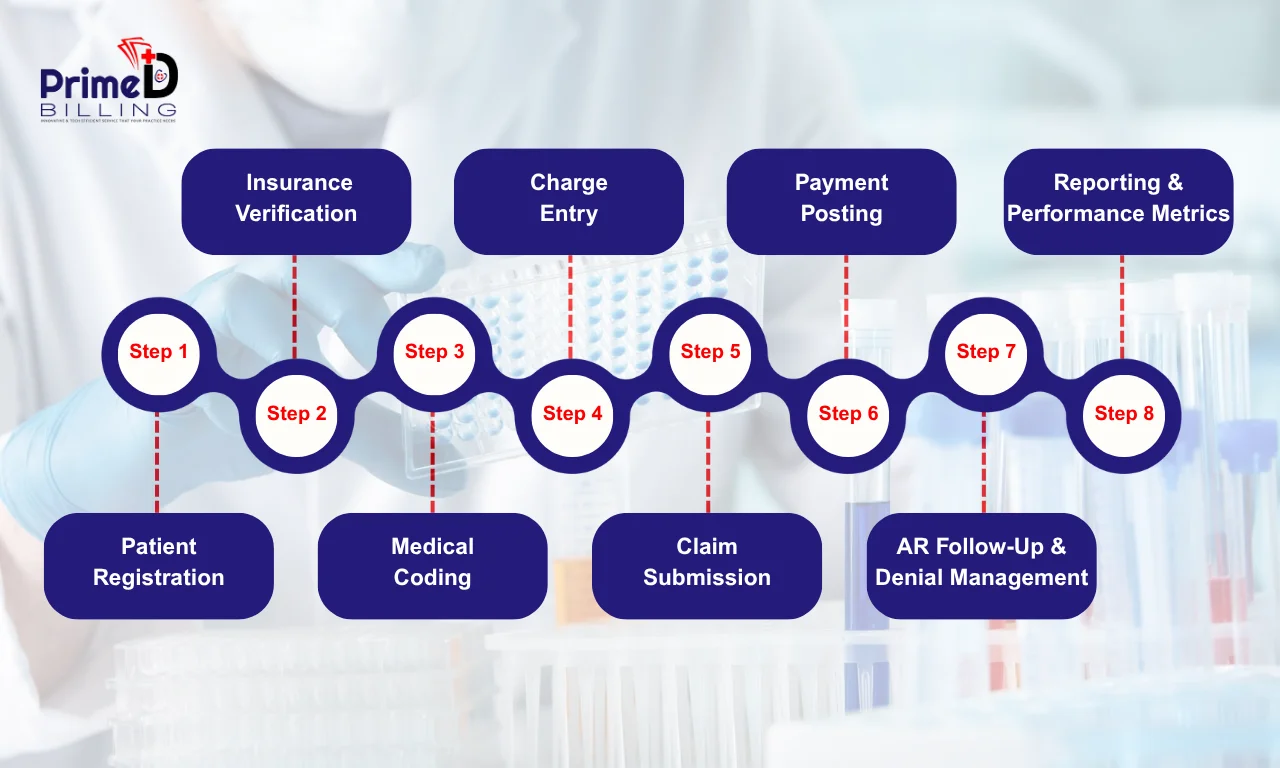
The medical billing cycle begins when a patient books an appointment and continues until the payment is received. Below are the major steps:
-
Patient Registration
The first step involves collecting patient insurance information along with demographics. Accurate intake registration reduces the chances of claim errors or denials. Incorrect or missing information may affect the entire billing cycle.
-
Insurance Verification
Medical billers perform insurance verification before the start of patient treatment. It is essential to identify:
- Coverage limitations
- Co-payments
- Deductibles
- Coinsurance
- Pre-authorization
- Insurance policy status
- Services covered
-
Medical Coding
Medical coders translate the patient’s diagnosis and treatment plan into standardized codes. They can do it during the patient’s visit or afterward. Incorrect or mismatched coding can lead to denials, audits, or compliance issues.
There are three main types of codes:
- CPT (Current Procedural Terminology)
- ICD-10 (International Classification of Diseases)
- HCPCS (Healthcare Common Procedure Coding System)
-
Charge Entry
Charge entry refers to assigning the codes to appropriate charges based on the providers’ fee schedule. Charge entry determines the financial value of a patient encounter. The biller must match them with the correct codes to ensure proper reimbursement.
-
Claim Submission
Medical billers compile the claim after charge entry and submit it either directly to insurance companies or through clearinghouses. Clearinghouses check for errors and correct them before submission.
Clean claims are processed faster. Missing or inaccurate data may result in rejections or denials.
-
Payment Posting
After insurers review claims, they send payment postings via ERA. This explains the paid, adjusted, or denied amounts. Insurers post these payment details into the provider’s billing system to maintain accurate financial records.
-
Denial Management
If a claim is denied, the biller reviews and corrects it or files an appeal when needed. Common reasons for denials include:
- Missing documentation
- Eligibility issues
- Incorrect coding
- Lack of authorization
Billers follow up consistently to recover the practice’s revenue.
-
A/R Follow-Up
Some claims get lost or remain unpaid. A/R Follow-up ensures no claim is left behind, improving the practice’s cash flow.
The A/R follow-up process includes:
- Contacting payers for delayed responses
- Following up with patients for outstanding balances
- Tracking unresolved claims
- Resolving error issues
How Does Patient Registration Affect the Billing Cycle?
Patient registration is the foundation of the entire medical billing cycle. Medical billers treat this step as a mission-critical input. They ensure quality checks and integrate with front office workflows for a smooth process.
-
Accurate Patient Demographics
Effect on Claims
Incorrect or incomplete patient demographics can lead to claim denials. Even a small error creates mismatches in the payer system such as incorrect name, DOB, or contact details.
Billing Team Solution
Medical billing companies cross-check patient demographics before claim submission. They identify errors and coordinate with front desk teams to prevent future denials.
-
Complete Insurance Details
Effect on Claims
Incorrect insurance details such as payer name or group number may route claims to the wrong payer, delaying adjudication and cash flow.
Billing Team Solution
Billers verify active coverage, payer IDs, and payer-specific requirements before claim submission.
-
Policy Validity Check
Effect on Claims
Claims are denied instantly if the patient’s policy is expired or inactive. This may create uncollectible balances for the provider.
Billing Team Solution
Medical billers confirm policy status and covered services through real-time eligibility tools to catch invalid policies early.
-
Avoid Data Errors
Effect on Claims
Formatting errors or simple typos can cause payment delays and mismatches with insurance systems.
Billing Team Solution
Billing teams use medical billing software and manual audits for high-value claims to ensure compliance and accuracy.
-
Front Desk Accuracy
Effect on Claims
The front desk acts as the first line of defense. Incorrect information entered here negatively affects the full billing cycle.
Billing Team Solution
Billing staff train front desk teams and establish registration checklists to ensure accuracy.
-
No Duplicate Records
Effect on Claims
Duplicate patient records may cause denials or compliance issues.
Billing Team Solution
Billers use unique identifiers like MRN and DOB to detect duplicates and coordinate with HIM teams.
-
Benefits Coordination
Effect on Claims
Incorrect Coordination of Benefits (COB) causes denials or overpayments requiring refunds.
Billing Team Solution
Medical billing companies validate COB and ensure claims are sent to primary and secondary payers correctly.
What Role Does Coding Play in the Process?
Medical coding acts as a translator between the clinical services and financial reimbursements. Its primary purpose is to ensure every diagnosis and procedure is accurately assigned to standardized codes. It helps payers understand the services properly and reimburse accordingly.
-
Purpose of Medical Coding
Medical coding is essential to create a shared billing language among providers, patients, and insurers. It helps them in consistent data tracking and reporting. Accurate medical coding speeds up the reimbursement process for the provider’s practice.
-
Link Between Services & Billing
Medical coding ensures that the clinical services are transformed into billing charges accurately. It helps billers properly document the procedures and convert them into claimable services.
-
ICD Diagnosis Codes
International Classification of Diseases (ICD) codes are used to document the patient’s diagnosis. These codes support the medical necessity of the patient’s treatment and help payers understand the justification of the procedures.
-
CPT Procedure Codes
Current Procedural Terminology (CPT) codes describe the procedures and treatments rendered to the patients. CPT codes reflect the nature of care and are essential for determining proper reimbursements.
-
HCPCS Supply Codes
The Healthcare Common Procedure Coding System includes codes for non-physician services such as medical supplies, equipment, and ambulance transport. These codes help billers convert such services into standardized codes understandable by payers.
-
Coding for Reimbursement
Medical coding helps providers get maximum reimbursements when codes match payer policies and fee schedules. It ensures claims meet payer-specific requirements, which may vary across insurance plans.
-
Avoiding Coding Errors
Keeping up with code updates is essential to avoiding claim denials. Outdated codes can lead to significant errors for providers. Medical billers ensure accurate code selection that aligns with clinical documentation and services.
-
Code Accuracy Compliance
Adhering to official coding guidelines and ethical standards is vital for compliance and security. Accurate compliance protects practices from surprise audits and penalties.
How Are Claims Submitted to Payers?
Submitting accurate claims to payers ensures timely reimbursements for the practice. Medical billers prepare, validate, submit, and track claims according to payer-specific requirements.
-
Claim Creation Process
Medical billers start by gathering all relevant data, including:
- Clinical documentation
- Charge entry
- Patient information
- Insurance details
- CPT/ICD codes
- Provider information
-
Clearinghouse Integration
Clearinghouses check the claim for errors, match payer IDs, manage feedback, and make edits before final submission.
-
EDI Format Standards
Medical billers use billing software that follows EDI standards such as ANSI 837 to ensure compatibility with payer systems and HIPAA compliance.
-
Portal-Based Submissions
For payers who do not accept EDI, billers manually submit claims through payer portals and use them for eligibility checks and follow-ups.
-
Payer-Specific Rules
Billers follow unique payer guidelines, including:
- Modifier usage
- Code bundling
- Frequency limits
-
Error Scrubbing Tools
Error scrubbing tools scan for coding mismatches, missing fields, and invalid combinations to reduce denials.
-
Submission Confirmation
Billers receive acknowledgment reports confirming the payer received the claim and indicating whether corrections are needed.
-
Tracking Claim Status
Billers track claim status through payer portals or calls, monitoring delays, denials, or requests for additional information.
How Do Providers Handle Denials and AR Follow-Up?
The billing team detects, corrects, appeals, and recovers revenue through a structured AR workflow to protect the provider’s financial performance.
-
Identify Denied Claims
Billers review ERA and EOB reports to identify denied claims and categorize them by denial type—coding, eligibility, or medical necessity.
-
Analyze Denial Reasons
They decode claim details and payer remarks to determine the exact reason for denial and decide whether to correct or appeal the claim.
-
Correct Claim Errors
If errors involve coding, coverage, or incorrect information, the billers fix them and resubmit quickly to prevent delays.
-
Initiate Appeal Process
When a denial requires reconsideration, the team files an appeal, prepares necessary documents, and submits within payer deadlines.
-
Track Appeal Status
Billers monitor appeals, escalate stalled cases, and provide additional documentation when required.
-
Monitor Aging Reports
Aging Reports reveal how long claims remain unpaid, helping billers prioritize old claims to prevent revenue loss.
-
Prioritize High-Value Claims
Billers focus on high-value claims first to maximize financial impact and ensure larger reimbursements are recovered promptly.
-
Optimize AR Workflow
Teams optimize AR workflows with task management tools, timely follow-ups, and preventing duplication of work.
What Metrics Define a Successful Billing Process?
A successful billing process is defined by quick and accurate claim submissions, faster reimbursements, and a consistently healthy revenue flow.
-
Clean Claim Rate
Clean claims processed on the first attempt speed up reimbursement and reflect accurate billing and coding practices.
-
Claims Paid on First Try
Claims fully paid on first submission strengthen cash flow by reducing delays and minimizing time spent on denials or follow-ups.
-
Days in Accounts Receivable (A/R)
Fewer days in A/R indicate faster payments and a more financially efficient practice.
-
Net Collection Rate
A high net collection rate shows how effectively the provider recovers the revenue they are owed.
-
Charge Lag Time
Charge lag measures the time from the date of service to claim submission. A shorter lag leads to quicker reimbursements and strengthens the entire revenue cycle.
FAQ'S
-
What are the steps of the billing cycle?

-
Who handles medical billing in hospitals?
-
What delays claim processing?
-
What are clearinghouses?

Partner with Prime Doc Billing Today
Let our experts handle your billing — streamline your revenue cycle and focus on patient care.