

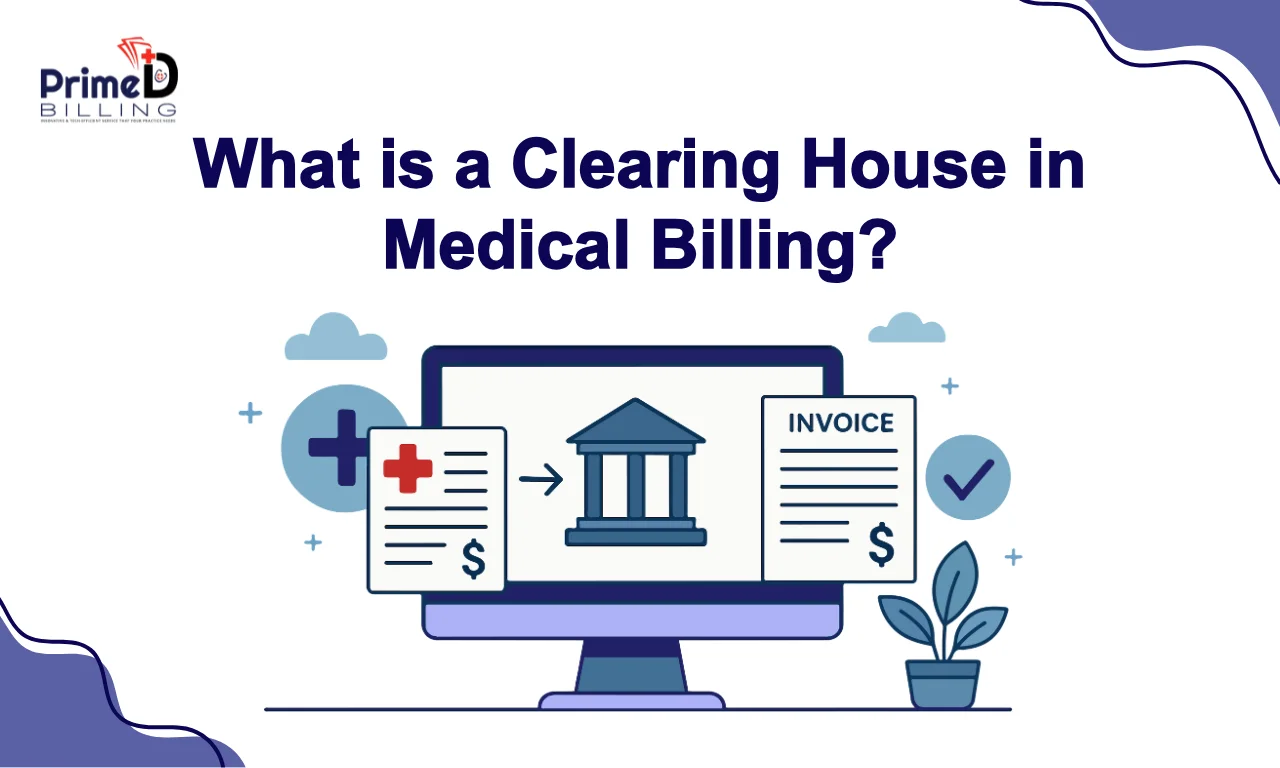
In medical billing, a clearinghouse is a third-party organization that acts as an intermediary between insurance companies and healthcare providers. The main purpose of a clearinghouse is to receive electronic claims from providers, scrub them for errors, and then forward the clean claims to insurance companies. This process reduces claim denials and speeds up reimbursements.
The role of a clearinghouse is to act as a trusted third party, simplifying and streamlining the claim submission process. It identifies the errors to improve the first-pass acceptance rate and enhance accuracy in the revenue cycle. This allows the providers to focus more on patient care while minimizing administrative workload.
To serve these purposes, clearinghouses come in various types, including direct-to-payer, network-based, independent, vendor-specific, and hybrid models. Each of them offers unique advantages depending on the provider’s payer relationship and claim volume. The healthcare providers can maximize efficiency by choosing the right type of clearinghouse for their claim submission process.

A medical claim doesn’t travel straight to the payer; instead, it passes through the clearinghouse. It is a crucial step that validates and refines the claim for successful submission. Here’s a step-by-step guide at how a clearinghouse processes a medical claim.
The healthcare providers prepare a claim after delivering healthcare services to the patients. This claim includes all the details of the provider, insurer, and patient, along with the necessary documentation. This claim is a request for payment to the patient’s insurance company.
The healthcare providers then submit the claims to the clearinghouse instead of directly sending it to the payer. The clearinghouse acts as an intermediate entity between the providers and the payer. They receive claims and prepare them for further processing.
The clearinghouse then performs a process called claim scrubbing to filter out the errors in the submitted claim. The claim is rejected back to the provider if any mistake or error is found in the claim. These errors include:
• Incorrect patient demographics
• Invalid insurance numbers
• Coding errors
• Missing authorizations
If the claim has all the required details and documentation, the clearinghouses then check if it is in the right format. Each insurance company requires the claim in a specific electronic format. This format is often ANSI X12 for the U.S. insurance payers.
The clearinghouses convert the claim into a standardized format. This ensures compatibility with the payer’s system.
Once the claim is aligned correctly into the valid format, the clearinghouses then send it to the payer. The insurance companies then perform a process called adjudication.
The insurance companies adjudicate the claim to determine whether the services are covered in the patient’s insurance policy. They also check for the required documentation for the medical necessity of the procedures. And at last, the insurance agencies check if the claim has the correct codes and charges.
After all the thorough review of the claim, the insurers then decide whether to approve, deny, or ask for further information for claim processing.
The insurance companies then send an Explanation of Benefits (EOB) back to the clearinghouses. The clearinghouses then forward it to the healthcare provider with details of how the claim was processed. It also includes payment amounts and the patient’s responsibility, if any.
In the last step, the insurance agencies post the payments or denials to the patient’s account. This step shows the accurate account balance. It helps the providers follow up on the unpaid balances with the patient.
They also check for errors and resubmit the claims if necessary.

The clearinghouses act as intermediaries between the providers and the insurance payers. This way, the providers don’t have to send the claims to each payer individually. The clearinghouses review and submit the claims, ensuring the claim reaches each payer efficiently.
The clearinghouses centralize the entire claim submission process. It also helps reduce administrative burden on the providers.
One of the main purposes of the clearinghouse is to check for claim accuracy. This includes verifying and checking proper coding, patient demographics, and valid insurance details.
The clearinghouses catch the errors before claim submission. This reduces the likelihood of claim denials, rework, and resubmissions.
Clearinghouses ensure that the data submitted to the payers is consistent and valid. They ensure that the required fields are filled correctly and the information aligns with the payer requirements. They also perform claim scrubbing, which maintains data integrity and compliance of the claim with industry standards.
Each insurer requires claim submission in different electronic formats. The role of the clearinghouse is to standardize claims into the correct format. It reduces errors that are related to the submission format and processing.
Clearinghouses submit the claims electronically to the respective payers. This helps reduce the errors associated with manual claim submission. It also speeds up the process. The clearinghouses also perform a real-time tracking of the claim status to stay up-to-date with the process.
It lowers the rejection rates by performing thorough error checks, formatting claims, and validating data. This helps the providers save time and resources used in rework and resubmission.
The clearinghouses act as a unified claim management platform. They streamline operations and improve reporting of the claims. This helps simplify the entire revenue cycle management by also speeding up the reimbursement process.
A direct-to-payer clearinghouse connects the healthcare provider directly to a particular insurance company. This helps the providers submit claims directly to the payer without going through a network of intermediaries.
This type of clearinghouse is ideal for providers who work with only a couple of major insurance companies.
For example:
A small clinic that accepts the claims primarily from Blue Cross Blue Shield (BCBS) will use a direct-to-payer clearinghouse to ensure faster claim transmission. It will include fewer to no intermediaries.
The network clearinghouse acts as a central hub between the providers and multiple insurance companies. They help the providers send a single claim to multiple insurers without the need to maintain multiple payer connections. This type of clearinghouse is suitable for practices with diverse patient populations.
For example:
A large practice with multiple specialities uses Availity clearinghouse, which connects hundreds of payers. In this case, the provider submits the claim to the network clearinghouse. Network clearinghouse then forwards each claim to the respective and appropriate insurer.
Commercial or Independent clearinghouses are third-party services that are available to any healthcare provider for a particular fee. They also offer additional services like eligibility verification, reporting, analytics, and claim scrubbing. It helps practices reduce errors and improve efficiency.
For example:
Office Ally is one of the most famous independent clearinghouses in the U.S. It offers the tools to detect errors before claim submission. This helps the practice reduce rejections.
Vendor-specific clearinghouses are integrated with a specific practice management system or EHR. These clearinghouses allow the claims to be submitted directly from the software. This way, the claim does not have to leave the platform at all. The main purpose of this clearinghouse is to simplify the workflow.
For example:
Kareo is an EHR that includes a vendor-specific clearinghouse. It allows the providers to submit the claims directly from the EHR. It also helps the practice track claim status within the same system.
A hybrid clearinghouse has the combined set of features from direct-to-payer and network clearinghouses. This type of clearinghouse has advanced claim management tools, reporting, and analytics. This clearinghouse is suitable for providers who need flexibility with their claim submissions.
For example:
Availity Essentials offers a hybrid approach. It connects the providers to multiple payers while also offering other services. These services include claim scrubbing, patient eligibility verification tools, and reporting dashboards.
The following are the most common errors that result in the clearinghouse rejections:
One of the most common errors in clearinghouse rejection is mismatched or incomplete patient information. This happens when the provided details do not align between the provider records and insurance databases.
Even the slightest error in the demographics section gets the claim rejected before it reaches the payer. It also causes a delay in the reimbursement.
Details like incorrect payer ID, policy number, or expired coverage cause clearinghouse rejections. This increases administrative workload with rework and resubmission of the claims. This rework also increases the risk of missing timely filing deadlines.
However, conducting real-time eligibility checks helps prevent insurance detail errors.
Outdated or incorrect codes, along with missing modifiers, cause clearinghouse rejections. Errors in coding are one of the top reasons for claim rejection in medical billing. It also leads to the risk of non-compliance.
Giving regular training to the staff helps prevent coding mistakes in the claim.
High-profile surgeries in medical billing, like MRI, CT scans, and surgeries, require pre-authorizations from the insurance companies. Missing referrals causes patients’ billing issues because of the rejections.
Maintaining a checklist of services that require preauthorizations helps prevent it in the future.
When the providers submit the same claim twice, the second one is referred to as the duplicate claim. If done intentionally, it increases the risk for payer penalties because of abusive billing practices.
The use of clearinghouse reporting dashboards helps avoid duplication before claim submission.
Each payer requires the claim to be submitted in a particular format. If the providers submit the claim in an unsupported claim format, the claim gets stuck at the clearinghouse. Clearinghouse scrubbing tools help convert the claim into the payer-required format.
An incorrect charge entry or a mismatched unit of service flags the claim as overbilled. The providers need to review claims with unusually high charges to ensure correct billing amounts.
Prime Doc Billing helps the practices optimize their clearinghouse use by ensuring each claim is scrubbed for errors and inefficiencies. Our certified coders maintain accuracy and compliance throughout every step of the claim submission process. Our team monitors clearinghouse rejection reports to prevent costly delays. This helps us improve first-pass acceptance rates and accelerate reimbursements. Partner with Prime Doc Billing today to strengthen your revenue cycle with a more efficient clearinghouse use.
Join hundreds of healthcare providers who have transformed their practice with our medical billing services in New York.
Let our medical billing experts review your revenue cycle and uncover hidden revenue opportunities.
Let our medical billing experts review your revenue cycle and uncover hidden revenue opportunities.

 (347) 650-2656
 (347) 650-2656
 info@primedocbilling.com


