(347) 650-2656
 (347) 650-2656
 info@primedocbilling.com


What is Medical Billing Outsourcing?
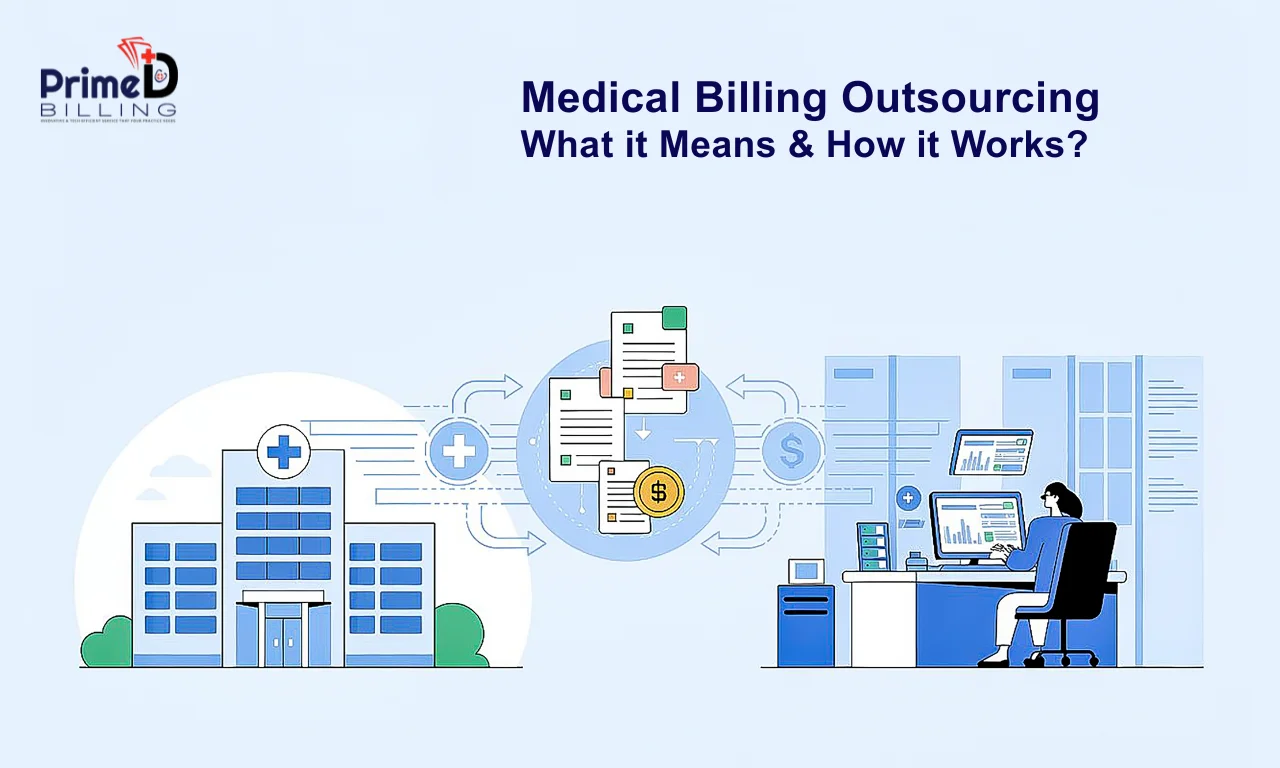
Medical billing outsourcing refers to the process by which a healthcare provider hires an external company to manage its billing and claim submission tasks. The medical practice delegates these responsibilities to experts who specialize in coding, claim processing, and revenue cycle management.
Outsourcing involves transferring financial and administrative processes to an externally hired professional billing company. Outsourcing helps healthcare providers focus more on patient care rather than the complex administrative paperwork and billing regulations.
The main goal of outsourcing medical billing is to improve revenue cycle efficiency, ensure compliance, and enhance data security. Direct access to certified billing professionals also helps the medical practice to reduce claim errors, accelerate reimbursements, and maintain consistent cash flow.
Medical billing outsourcing is the key component of Healthcare Business Process Outsourcing (BPO). Healthcare BPO covers a wider range of non-clinical and administrative tasks like medical transcription and patient support. However, medical billing outsourcing focuses specifically on the revenue and finance-related aspects of healthcare management.
In-house vs Outsourced Medical Billing
| In-House Medical Billing | Outsourced Medical Billing |
|---|---|
| In-house billing refers to when the healthcare provider’s own staff handles all the billing internally. | Outsourcing refers to hiring an external company that specializes in medical billing and revenue cycle management to handle the provider’s billing services. |
| The healthcare provider has direct control over day-to-day billing operations. | The provider relies on a third-party vendor for professional expertise and operational execution. |
| High setup costs — hiring, training, salaries, software licensing, and infrastructure. | Lower upfront costs — typically only the service fee; vendor handles staffing and tools. |
| Higher risk of human errors or delays if staff are inexperienced or overloaded. | Professional billing teams provide greater accuracy and faster turnaround times. |
| Best when the practice needs close control and has resources to invest in staff & systems. | Best when the practice prefers to reduce administrative burden and leverage specialized expertise. |
Pros and Cons of Outsourcing Medical Billing
Outsourcing medical billing plays a crucial role in helping healthcare organizations manage their financial operations efficiently. It ensures that providers are reimbursed accurately and on time without having to handle the administrative burden in-house. By partnering with professional billing companies, healthcare practices can benefit from cost savings, expert coding, and faster claim processing. Outsourcing also provides access to advanced billing technology, improved compliance, and the flexibility to focus more on patient care.
However, outsourcing also comes with certain challenges. Healthcare providers may face communication gaps, reduced control over billing operations, and concerns about data security or confidentiality. Additionally, choosing an inexperienced billing partner can lead to claim errors or delayed payments.
Overall, while outsourcing medical billing offers significant advantages in terms of efficiency and revenue optimization, it’s important for providers to carefully evaluate both the benefits and potential drawbacks before making the decision.
-
Pros
Cost Efficiency
When a healthcare practice outsources its billing services, it eliminates the need to hire, train, and maintain an in-house billing team. Outsourcing medical billing services offers cost efficiency while reducing overhead expenses such as salaries, infrastructure, and software costs.
Expertise and Accuracy
Medical billing companies have certified billing professionals who ensure accurate coding and timely claim submissions. The experts work on improving reimbursement rates by reducing errors in the first attempt of claim submission.
Advanced Technology Access
Medical billing companies have access to the latest billing software and analytics tools. These tools help in faster claim processing and real-time reporting.
Improved Compliance
Professional billing staff stay updated with the latest healthcare policies and regulations. They also stay up-to-date with separate payer policies to ensure compliance with HIPAA and other necessary standards.
Focus on Patient Care
Medical billing teams take on all the administrative work externally. This helps healthcare providers focus more on patient care and devote their valuable time to practice growth.
-
Cons
Less Operational Control
Outsourcing medical billing to billing companies often makes healthcare providers feel like they have reduced control over day-to-day operations. Providers often get limited visibility on how claims are processed or how rejections are handled.
Dependence on Third-Party Vendors
Outsourcing also creates a long-term reliance on an external company for revenue cycle management. This dependency can be challenging if the medical billing company faces internal issues like staff shortages, software failures, or compliance lapses.
How Does Outsourcing Medical Billing Work?
Outsourcing medical billing works by transferring a healthcare provider or practice’s billing and claim management responsibilities to a specialized medical billing company. Instead of handling coding and claim submission in-house, these tasks are performed by certified billing professionals using advanced billing software.
The process ensures that the medical claims are prepared accurately and submitted on time, along with a timely follow-up to secure faster reimbursements. It typically begins with the selection and contracting of a reliable billing service, followed by the data handover and system setup. Once the setup is complete, the billing team takes over routine operations while maintaining a healthy revenue cycle.
-
Select and Contract with a Billing Service
Selecting a medical billing company is the first and most crucial step in outsourcing medical billing. The healthcare provider evaluates and then chooses a medical billing company to manage their billing operations. The following are the few steps of what happens in this stage:
The healthcare provider first determines what they need for services, which can be insurance claims processing, patient billing, payment posting or denial management.
The healthcare provider or facility then conducts a research on different billing companies and checks their experience with different specialties, software compatibility, compliance standards and client reviews.
Some healthcare facilities issue a Request for Proposal (RFP) to get bids from multiple billing companies and then compare their pricing structures. This pricing structure varies from percentage of collections to a per-claim fee.
The healthcare facility also verifies the billing company's credentials which include data security practices, compliance with healthcare laws, certifications, and references from other clients.
Once the provider chooses a billing company, both parties agree on the contract terms which include:
- What the billing company will handle
- Performance expectations
- Data protection and confidentiality clauses
- Renewal or termination conditions
After agreeing on a mutual contract, both parties sign a Service-level Agreement (SLA) which serves as the official start of partnership.
-
Data Handover/ Setup
Once the contract is finalized, the next step is to set up systems and transfer necessary data to the billing company. This helps them begin their work efficiently. This step includes:
System Integration: It is when the billing company connects their software to the healthcare provider’s EHR (Electronic Health Record) or Practice Management System. This integration allows them to exchange confidential data securely.
Data Transfer: The healthcare provider shares essential information with the billing company. This information includes patient records, insurance details, provider credentials, fee schedules and payment data.
Software Setup: The billing company then configures user accounts, permissions, and data sharing protocols. They also establish secure communication channels and data encryptions to ensure compliance with the privacy laws.
Workflow Alignment: The billing company’s team is trained to align with the provider’s workflow. Sometimes, the billing team also gives guidance to the provider’s staff on how to submit accurate information for billing.
Testing Phase: After the system is handed over to the billing company and they align with the provider’s workflow, the systems are tested with sample claims to ensure smooth transmission. The billing team investigates proper integration between platforms before going live with the services.
-
3. Coding and claim preparation
4. Claim submission to payers
5. Follow up, denial management and payment posting
6. Patient billing and collection
7. Reporting and analytics
How Much Does It Cost to Outsource Medical Billing?
The cost of outsourcing medical billing varies depending on the size and complexity of healthcare practices along with their claim volume. However, outsourcing can be a cost-effective solution for healthcare practices seeking to reduce administrative burden. The following are some of the most common pricing models followed by medical billing companies:
-
Percentage-Based Model
In this model, the billing company charges a percentage of the total collections received from the insurance companies and patients. The average percentage charged for small clinics ranges from 6% to 10%, whereas large medical setups or hospitals are charged around 3% to 5%.
This model is best for providers who want their costs to scale with revenue. One advantage is that it aligns the billing company’s incentives with the provider’s success. It is easy to understand and track, and doesn’t require a fixed cost if collections are low.
-
Fee-for-Service Model
The billing company charges a fixed fee for every service performed. For example, $10 for each claim submission or $15 for denial management.
This model is best for practices that want clear control over billing tasks and outsource only particular parts of their revenue cycle. One advantage is transparency: providers pay only for what they use. This model is most suitable for small clinics.
-
Hybrid Model
A hybrid model combines percentage-based and fee-for-service approaches. For example, a billing company may receive a basic monthly fee along with 3-5% of the practice’s commission.
This model is best for practices that want predictable costs while incentivizing performance. It balances fixed and variable costs, suitable for large practices with multiple providers or specialties.
-
Per-Claim Model
Practices are charged a flat rate per claim, regardless of the claim’s value. The range depends on complexity and specialty.
This model is best for mid-sized practices with predictable claim volumes. It is easy to budget since the cost is tied to the number of claims, not revenue amounts.
-
Hourly Rate Model
Billing companies charge an hourly rate for staff time spent on the practice’s billing tasks. Rates typically range from $20 to $40 per hour depending on skill level and location.
This model is most suitable during peak workloads or when in-house staff are unavailable. Practices requiring billing services for cleanup projects like backlog claims or old AR follow-ups also opt for this model.
Medical Billing Outsourcing Company
A medical billing outsourcing company is a third-party billing services provider that handles the entire revenue cycle process and manages billing operations for healthcare practices. Such companies employ certified and professional coders and revenue cycle experts whose main goal is to help healthcare providers maximize revenue and maintain financial stability.
-
Why Should You Hire a Medical Billing Outsourcing Company?
Hiring a medical billing outsourcing company proves to be one of the smartest business decisions for many healthcare providers. Outsourcing helps relieve the administrative burden while enhancing overall financial performance of a practice.
With the right billing partner, healthcare providers can achieve faster reimbursements and improved compliance, with more time to focus on patient care.
-
Should I Outsource My Medical Billing?
Yes, practices should outsource medical billing services as it can be a strategic move for healthcare facilities that want to reduce their administrative workload and improve cash flow. The right choice depends on the provider’s resources, staff expertise, and control preferences.
A reliable billing partner brings efficiency and financial stability to the practice with a long-term commitment.
Partner with Prime Doc Billing Today
Let our experts handle your billing — streamline your revenue cycle and focus on patient care.