

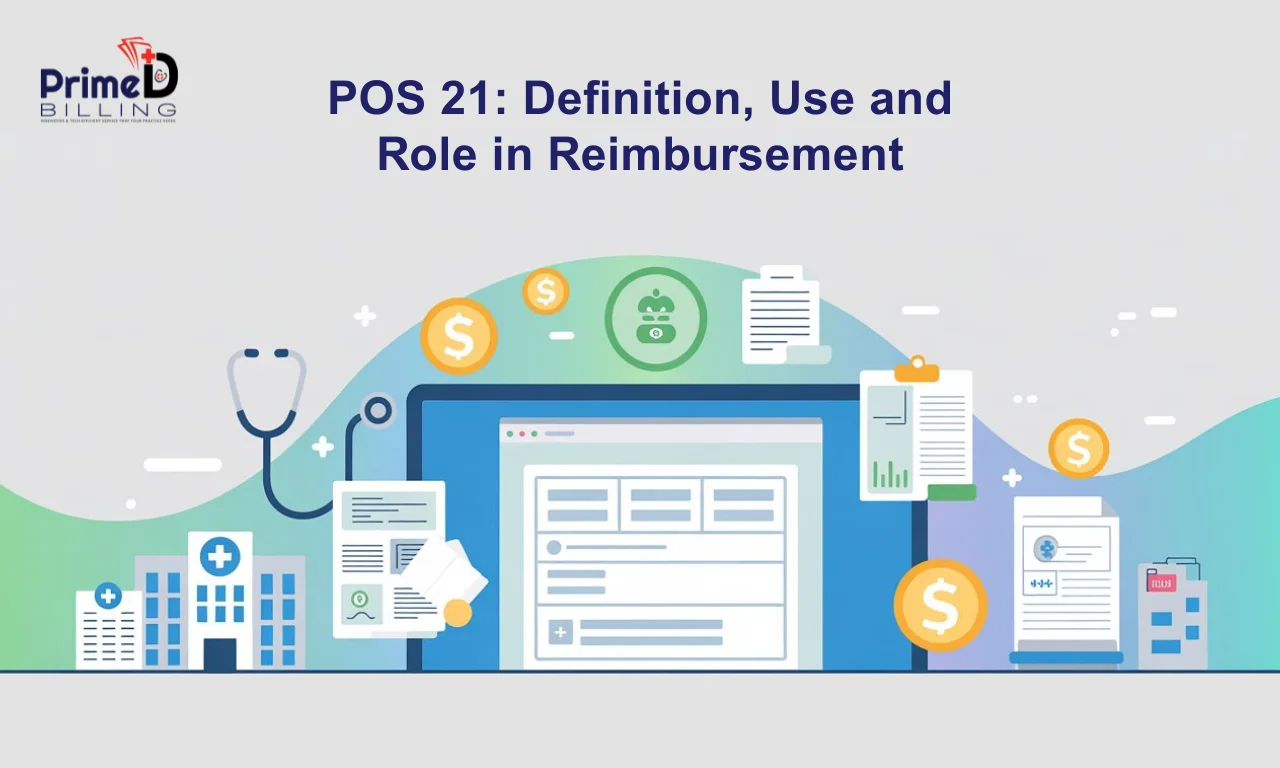
Place of Service (POS) 21 in medical billing represents Inpatient Hospital services. Medical billers use POS 21 when the healthcare services are provided to a patient who has been formally admitted to a hospital. 21 POS code is used when the services are provided within a licensed hospital facility that have higher reimbursement rates.
Place of Service 21 code plays a crucial role in determining the reimbursement of medical services. The code identifies the inpatient hospital location and appropriate payment methodology. 21 POS code affects reimbursement rates which are relatively higher for inpatient care. Accurate POS 21 coding helps reduce claim denials and ensures compliance with the CMS and payer-specific billing guidelines. Inconsistent POS 21 coding results in claim errors.
Some of the most common errors involving POS 21 include using the code for outpatient visits, inadequate documentation, upcoding and duplicate claims. The errors involving POS 21 codes can be resolved by verifying inpatient patient admission status before billing, maintaining accurate documentation and conducting regular internal audits to support compliance and reduce the risks for denial.
POS 21 stands for ‘Inpatient Hospital’. The code indicates that the patient received comprehensive medical care while being formally admitted to the hospital. Unlike non-facility settings such as physician’s clinics, POS code 21 strictly applies to inpatient hospital-based admissions.
Accurate use of place of service code 21 helps the payer determine correct reimbursement rates. 21 POS in medical billing prevents delays or claim denials due to mismatched service locations.

Place of Service 21 (POS 21) should only be used when the patients meet the following three criteria:
POS 21 only applies when the patient is formally admitted to the hospital. Being admitted in a hospital refers to at least one overnight stay. The patient receives continuous medical care during the admission.
Place of Service 21 applies when the patient care takes place in a licensed hospital facility. The hospital setting includes general hospitals, specialty centres and acute care units. Accurate designation of a hospital setting reflects correct reimbursement rates.
POS 21 covers all the comprehensive medical care services rendered during an inpatient stay. The inpatient care services include the doctor’s visit, diagnostic tests, medical procedures, nursing care, therapies and other documented medical treatments.
Place of service 21 should not be used in the following situations:

Place of Service 21 plays a vital role in reimbursement as it identifies the location where the medical services were provided. The location of medical care has a direct impact on the payment method which affects reimbursement rates of the service.
POS 21 code identifies the location when the medical services are provided to the patients, which is an inpatient hospital setting. Accurate identification of the location is essential for payers to reflect the correct care environment. Precise location information ensures the correct application of reimbursement rates.
Accurate POS 21 coding helps the insurance payers decide the appropriate payment methodology. Inpatient hospital services often follow different payment methods than the non-facility or outpatient services. Using POS 21 correctly ensures the processing of claims under the correct payment framework.
Reimbursement rates vary depending on where the medical services were provided to the patients. Accurate use of Place of Service 21 codes is important for the proper reimbursements. Inpatient hospital care has typically higher rates as compared to outpatient or non-facility based care.
Incorrect or inconsistent POS coding is the main reason for claim denials. Using POS 21 only when the patient meets the criteria of inpatient hospital admission helps reduce the risk of claim denials. Preventing claim denials by using POS 21 correctly helps ensure smoother and faster reimbursement.
Accurate Place of Service 21 coding helps ensure payer and regulatory compliance by clearly indicating the setting and type of medical care. Valid use of POS 21 coding reduces the risk of audits and penalties resulting in reimbursement disputes.
Place of Service 21 plays a vital role in reimbursement as it identifies the location where the medical services were provided. The location of medical care has a direct impact on the payment method which affects reimbursement rates of the service.
Using POS 21 for patients who are not admitted as inpatients often leads to claim denials. Incorrect application results in inaccurate reimbursements and an increased risk of compliance issues.
Using 21 pos coding with CPT or HCPCS codes that are billed under different settings triggers denials and compliance risks.
Insufficient or missing documentation to support the inpatient admission increases the risk of claim denials. Documentation gaps often result in compliance violations.
Submitting multiple claims for the same inpatient service under Place of Service code 21 results in overpayment. Duplicate billing increases audit exposure and often results in claim denial.
The incorrect use of 21 pos in medical billing to increase reimbursement results in the upcoding risk. The upcoding for 21 pos raises compliance risk and is considered fraudulent.
Applying POS code 21 to services provided outside a hospital setting such as physician’s office leads to claims denials and compliance penalties.
Following are the most common errors involving POS 21:
Following are the best practices of using POS 21:
Frequently Asked Questions
CMS rules for using POS 21 involves ensuring that the code is only used for the services provided to patients formally admitted to a hospital.
CPT guidelines require that only inpatient-appropriate CPT and Evaluation & Management (E/M) are reported when using POS 21.
| POS 21 | POS 11 | |
|---|---|---|
| Setting | POS 21 applies to the services provided in an inpatient hospital setting. | POS 11 applies to the services provided in the provider’s office or clinic setting (non-facility) |
| Admission | Formal inpatient admission is required for POS 21. | POS 11 coding is for outpatient care, hence no admission required. |
| Reimbursement | Reimbursement for POS 21 is higher according to inpatient hospital rates | POS 11 reimbursement is comparatively lower, aligning with the physician reimbursement rates. |
| POS 21 | POS 22 | |
|---|---|---|
| Setting | POS 21 applies to the setting of an inpatient hospital admissions. | POS 22 refers to the services provided in an outpatient hospital. |
| Admission | The patient is admitted formally in a hospital in POS code 21. | In POS code 22, the patient is not admitted to the hospital. |
| Services | POS code 21 includes all inpatient hospital services. | POS 22 coding involves services like outpatient surgery, diagnostics, and outpatient hospital services. |
Yes, CPT code 99222 is for initial hospital care and hence to be used with POS 21 when the patient is admitted to the hospital.
No, CPT 90834 is for psychotherapy and hence it includes only 45 minutes with the patient. Therefore, it cannot be billed with Place Of Service 21.
Join hundreds of healthcare providers who have transformed their practice with our medical billing services in New York.
Let our medical billing experts review your revenue cycle and uncover hidden revenue opportunities.
Let our medical billing experts review your revenue cycle and uncover hidden revenue opportunities.

 (347) 650-2656
 (347) 650-2656
 info@primedocbilling.com


