

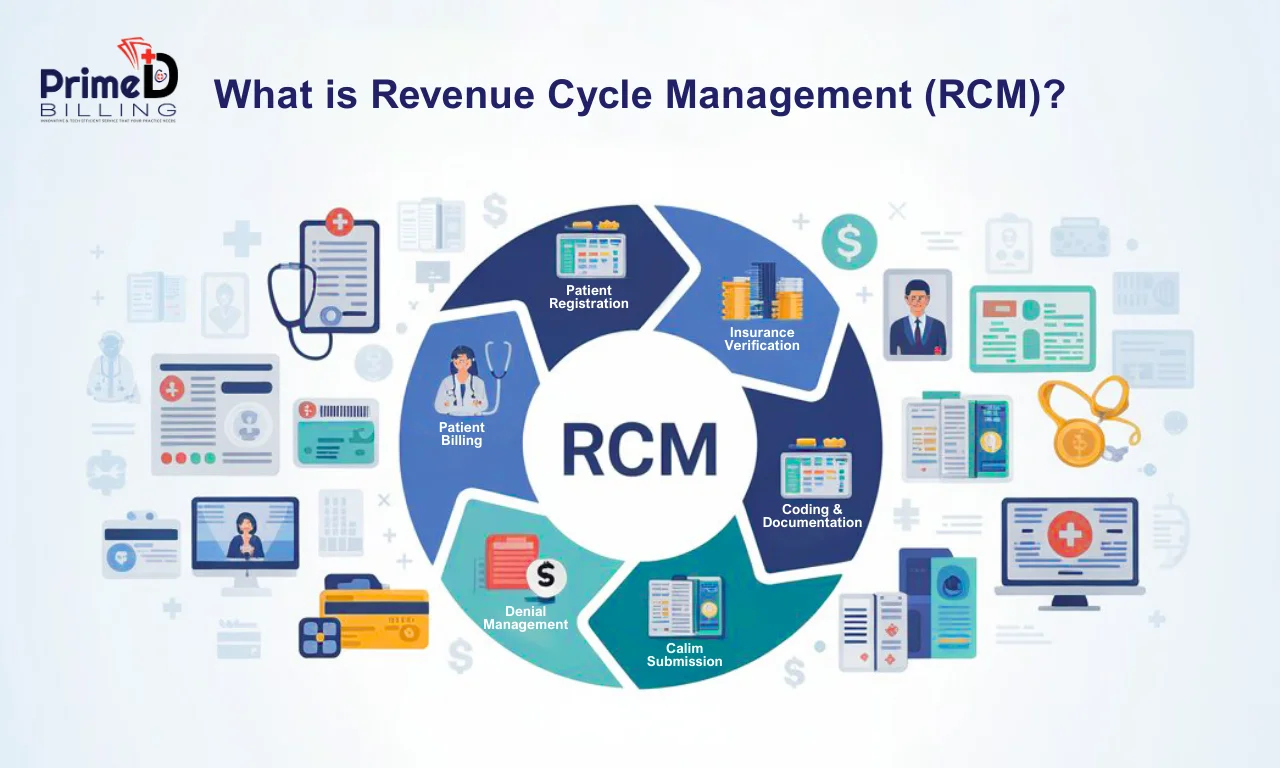
Revenue Cycle Management (RCM) is a comprehensive process healthcare organizations use to manage their administrative, clinical, and billing tasks. RCM is a process used to track revenue from patients, from their initial appointment to their final payment of balance, according to the Healthcare Financial Management Association (HFMA). Accurate handling of RCM results in the maximum payment collection rate of the practice. The role of RCM in reimbursements is critical as it fills the gap between patient care and financial compensation by accurate coding and submission of medical claims.
The entire RCM process is divided into three core components: front-end, mid-cycle, and back-end components. The front-end revenue cycle is composed of patient scheduling and registration, insurance eligibility verification and getting prior authorization, designed to prevent initial errors. The middle revenue cycle consists of clinical documentation, medical coding and capture charge, to ensure the accurate billing of every claim. Lastly, the back-end revenue cycle focuses on claim submission, payment posting, denial management and payment collections, along with reporting and analytics.
The three components of RCM all-together brings multiple benefits including maximum cash flow, operational efficiency and regulatory compliance for the practice. The primary goals of RCM are to reduce claim denials, maximize reimbursements, and enhance patient’s financial responsibility transparency.
Despite the goal implication in the entire process, RCM faces multiple challenges. The challenges include incomplete patient or insurance information, evolving payer rules, and difficulty in patient collections. Revenue cycle management is improved by implementing automated front-end tasks, integrating EHR with billing systems and offering flexible payment options to the patients.
Revenue Cycle Management is the process of optimizing Revenue cycle’s various activities to maximize reimbursement and improve the claim’s timeliness and accuracy, according to the National Institute of Health.
RCM is the financial process healthcare providers use to manage and track the practice’s revenue. RCM connects patient care with financial stability by ensuring the healthcare services are accurately documented, coded, billed and reimbursed.
Revenue cycle begins when a patient schedules an appointment at the provider’s office and continues until the healthcare providers receive their final payment collection for the services rendered. The revenue cycle in healthcare is the process that is used to track revenue from patients and insurance companies.
The revenue cycle includes patient registration, insurance verification, charge capture, medical coding, claim submission, payment posting, denials management, and patient collections to ensure healthcare providers are reimbursed properly.
The steps of the revenue cycle are crucial in healthcare because it directly links patient care with the financial health of an organization. Efficient revenue cycle reduces payment delays to promote a consistent cash flow for the practice’s growth. Whereas, proper documentation and coding helps cut down administrative delays in the revenue cycle. Reduced administrative delays help the organization stay up-to-date with regulatory compliance, allowing healthcare providers to deliver quality patient care.
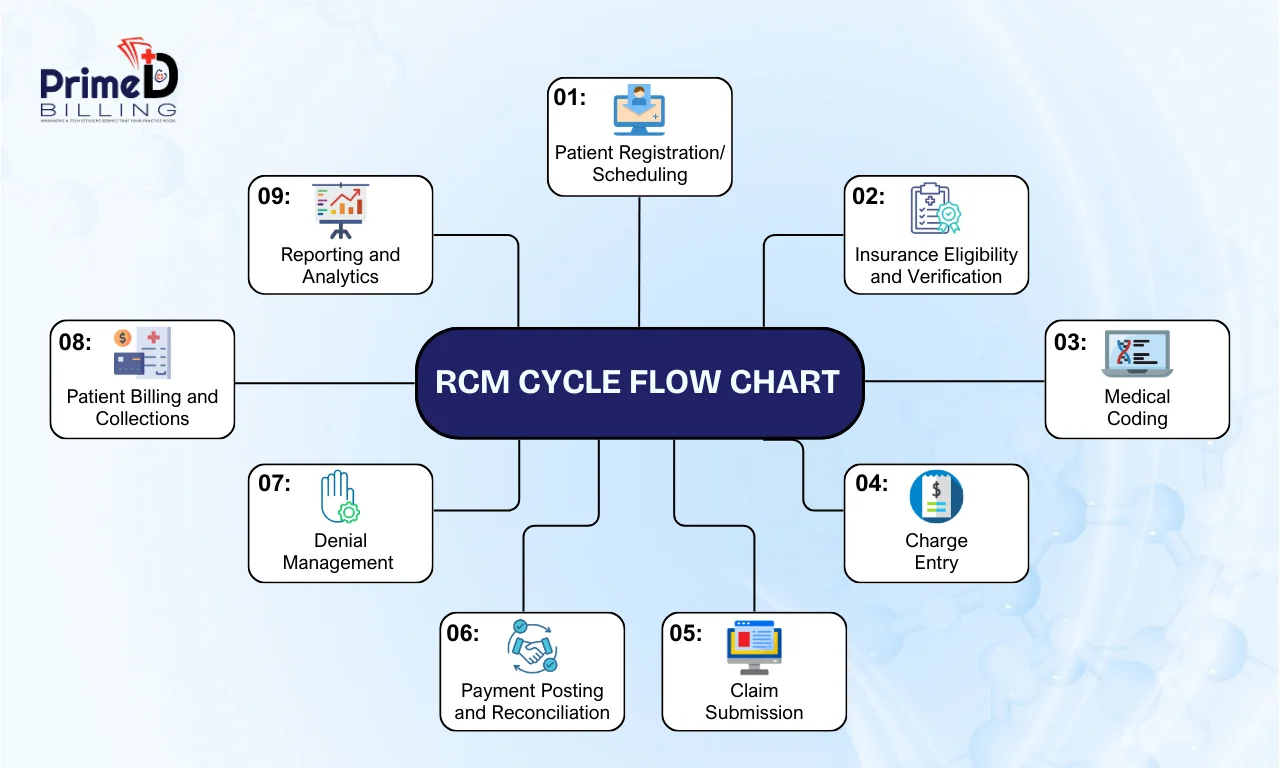
The Revenue Cycle Management (RCM) process consists of several interconnected steps, which includes:
Patient registration refers to the collection of a patient’s personal information like name, contact and insurance details. Patient registration takes place when the patient comes to schedule an appointment with the healthcare provider. Accurate registration helps the medical billers prevent downstream errors.
Errors in patient registration impacts the entire billing process causing claim denials and delayed payments.
Insurance eligibility and verification is one the key steps of the RCM process. In this step, the medical billers check if the patient’s insurance is active. Insurance verification determines the type of coverage for patients, deductibles, and pre-authorization requirements (if any).
Medical coding includes the translation of documentation into standardized codes. Medical coders translate ICD-10, CPT, HCPCS, and other state-specific codes for proper understanding of the services provided.
Charge entry refers to the recording of all billable services, medications, tests, and procedures done by a healthcare provider. Each service has a particular code, ensuring no service goes unbilled.
Claim submission is a key step in medical billing where claims are submitted to the insurance companies for reimbursement after accurate coding. Claims are mostly submitted electronically via revenue cycle management platform or with the help of a clearinghouse.
Cleaner claims in medical billing speeds up the payment without any delay in the revenue of a practice.
Payment posting is a record of payments received from the insurance companies and patients. Whereas, reconciliation is a process of matching the payments received with the expected payments to ensure accuracy. In case of an error in reconciliation, necessary adjustments for co-pays and underpayments are made.
Payment posting and reconciliation helps keep the patients accounts up-to-date while providing accurate financial reporting for the organization.
Revenue cycle management specialists review the claim in case of denial. Denial management includes the correction of errors, completing missing documentation, and resubmitting the claims.
After the insurance companies have reimbursed the practices for their services, the patients are billed for co-pays and deductibles. Proactive follow up on the overdue accounts is essential to improve transparency about the patient’s financial responsibilities. The financial transparency helps maintain patient trust and satisfaction with the healthcare providers.
Financial reports are a critical step of the revenue cycle management process. Reporting and analysis helps identify bottlenecks or inefficiencies to improve RCM process. Identifying the cause of inefficiencies ensures long-term sustainability of the healthcare organizations.

Revenue Cycle Management (RCM) is essential in healthcare to ensure efficient financial operations while supporting quality patient care. Following are the benefits of Revenue Cycle Management in healthcare.
1. RCM ensures timely claim submissions and faster reimbursements to help healthcare organizations maintain a steady revenue and income.
2. Accurate documentation, coding, and billing in RCM minimizes denial and delayed claims. Minimal denials result in an increase in overall reimbursement rates.
3. Streamlined and automated RCM process saves time and cost while taking off the manual workload. Automated RCM helps the providers focus more on patient care.
4. Revenue Cycle Management provides clear insight into payments and outstanding balances. Transparency in billing helps the organization make informed financial decisions.
5. RCM helps the patients become aware of their financial responsibility beforehand to avoid billing surprises and payment delays.
6. Transparent billing and clear communication in RCM improves patient satisfaction while reducing financial responsibility-related confusions.
7. RCM helps the healthcare providers stay compliant with changing billing policies and healthcare regulations. Staying up-to-date with the changing rules helps reduce audit risk and penalties.
8. Accurate reimbursements with RCM helps the healthcare providers invest in staff, equipment, and technology. Maximum revenue recovery supports long-term organizational growth.
9. Revenue Cycle Management generates data related to financial and operational insights to make informed decisions and design strategic plans to get maximum reimbursements.
10. RCM works on cost control by identifying areas to reduce expenses and billing errors, while optimizing reimbursement outcomes.
Since outpatient services are provided within a facility, using the correct POS 22 code is crucial, as it affects the billing and payment structure. When POS 22 is used, the hospital bills both a facility fee and the provider’s professional fee, so incorrect coding can result in underpayments for facility-based services.
The medical services that are provided under POS code 22 are reimbursed at a facility rate. The facility rates are typically higher than the non-facility rates even when the service provided to the patients is the same. Using Place of service code 22 ensures that the healthcare providers receive appropriate high-cost compensation for treating outpatients.
The correct use of POS 22 in medical billing decreases the likelihood of claims being denied which results in delayed reimbursements. Accurate POS coding 22 ensures timely reimbursements and avoids the loss of revenue for healthcare facilities.
Using POS 22 code accurately reflects the hospital’s compliance with CMS rules and payer policies. Regulatory compliance protects the healthcare facilities from external audits, penalties, and legal issues.

Following are some of the primary goals of revenue cycle management:
1. One of the main goals of RCM is optimized revenue collection. Optimization in reimbursement occurs by reducing claim denials and improving billing accuracy.
2. Enhancing cash flow efficiency is important for the providers to cover healthcare expenses and deliver quality care to the patients.
3. Regulatory compliance is the most critical goal of the Revenue Cycle Management (RCM) process. Regular compliance checks to maintain billing and coding standards is important to avoid legal issues and penalties.
4. RCM aims to improve patient satisfaction and engagement by simplifying billing and creating financial responsibility transparency.
5. Revenue cycle management focuses on accelerating payments by shortening the time between service delivery and final payment.
6. One of the most important goals of RCM is to enable healthcare organizations to plan for growth and resource allocation by generating actionable data and reports.

The three main components of RCM are:
Front-end revenue cycle covers all the activities that occur before the patient receives care. The activities include patient registration and insurance verification. Confirming the coverage prior to medical care helps prevent claim issues later in the RCM cycle.
The middle revenue cycle includes clinical and billing processes that happen during the patient care, or right after it. The clinical and billing processes include medical documentation, medical coding, charge capture and claim submission. The middle revenue cycle plays an important role in ensuring proper reimbursement.
Back-end revenue cycle includes the activities conducted after the medical care provided to the patients. The back-end activities include payment posting, patient billing, collections, and denial management. Back-end revenue cycle focuses on maximizing revenue collection by proactive followups on unpaid claims.

Some of the most common challenges in revenue cycle management are:
One of the biggest challenges in revenue cycle management comes with complex billing and coding rules. Mistakes in ICD-10, CPT, and HCPCS cause claim denials and underpayments.
Outsourcing medical billing and coding to the professional billing companies helps ensure accuracy and consistency.
Frequent changes in the insurance companies’ policies and requirements creates confusion and billing errors among healthcare providers.
Staying up-to-date with the payer policies and regular staff training ensures accuracy and helps reduce billing errors.
One of the most common challenges in RCM is non-compliance with the HIPAA and billing regulations, resulting in audits and fines.
Maintaining regular audits to identify recurring issues helps the healthcare providers stay compliant with HIPAA and state-specific policies.
Incomplete or incorrect data in revenue cycle management leads to claim rejection and billing errors.
Electronic health record (EHR) systems are integrated with RCM to regularly clean and validate patient and insurer data.
Unpaid patient balances in the RCM process or slow insurance reimbursements affect the healthcare practice’s financial stability and cashflow.
By monitoring the Accounts Receivables (A/R) closely and setting up automated payment reminders helps the billers improve cash flow of the practice.
Maintaining RCM and EHR are costly. Technology integrations require staff training and errors cause workflow disruptions.
Investing in user-friendly RCM platforms and conducting regular system testing ensures smoother operations.
The best way to improve revenue cycle management process is enhancing both patient experience and operational efficiency:
One of the primary steps to improve revenue cycle management is to strengthen the front-end process. Accurate collection of patient demographics and insurance details helps prevent claim denials and delayed payments. Pre authorization for services that require payer approval also improves the overall RCM cycle.
Each insurance company has their own set of rules, billing requirements and coverage policies. Regular review of payer contracts and guidelines helps prevent billing errors and minimizes revenue loss for the practice.
Clear communication of a patient’s financial responsibilities is very important to improve the revenue cycle management process. Offering multiple payment options increases the collection rate and reduces accounts receivables.
Implementing RCM and EHR software improves accuracy and speeds up the reimbursement process. Integration between billing and clinical systems reduces duplicate work and streamlines workflow automation.
Tracking denied claims to identify root causes and recurrent patterns helps reduce claim denials. Quick submission of corrected claims maximizes reimbursement and improves overall cashflow of the revenue cycle management process.
Regular staff training on updated payer policies and coding standards helps minimize claim rejection and improve the overall RCM process.
Transparent billing statements and clear explanation of a patient’s financial responsibility enhances patient’s trust and experience with the healthcare provider. Offering the patients a support service to answer financial questions also encourages timely payments.
Tracking metrics in accounts receivables and identifying bottlenecks and inefficiencies allows the healthcare organizations to optimize their revenue cycle. Monitoring key performance indicators is the best way to improve RCM of a practice.
Frequently Asked Questions
Revenue cycle operations are a series of clinical and administrative processes used by Revenue cycle management companies to manage billing operations and payment collections.
A revenue cycle manager is an RCM specialist responsible for managing the entire billing and financial operations of a healthcare organization.
RCM software is a digital platform that manages and automates multiple revenue cycle tasks, including patient registration, insurance verification, payment posting, denial tracking, and reporting.
The best software for revenue cycle management (RCM) is Athenahealth. However, the RCM software being the best for an organization depends on the size and needs of that healthcare facility.
Revenue cycle management (RCM) services are a set of operations specialized revenue cycle management companies provide to manage a healthcare organization’s revenue cycle. The set of operations include billing, coding, claim submission, denial management, reporting and analytics.
Revenue cycle management begins when the patient comes to the provider’s office or a healthcare organization for registration.
The revenue cycle ends when all payments are collected from both patients and the insurance companies. However post RCM services like denial appeals and claim reconciliation are considered the back-end process and ensure that the cycle fully ends.
No, the revenue cycle management also exists in other industries and fields like utilities and insurance. However, revenue cycle management is mainly associated with healthcare because of the complex billing, coding and reimbursement process.
Revenue cycle management is important to ensure that the healthcare providers are reimbursed timely and accurately. Effective RCM improves cash flow, operational efficiency and patient experience.
Poor revenue cycle management leads to claim denials or delayed claims. Poor RCM also leads to lost revenue of a practice and non-compliance issues resulting in negative patient experience.
| Front-end RCM | Back-end RCM | |
|---|---|---|
| Stage | Front-end RCM manages operations that occur before the services are provided to the patients. | Back-end RCM manages the operations that happen after the services are rendered by the patients. |
| Key Services | Front-end RCM handles patient registration, scheduling, insurance eligibility, verification and prior authorizations. | The services included in Back-end RCM are medical coding, claim submission, payment posting, accounts receivable, and follow-ups. |
| Impact | Patient demographics and insurance details in front-end RCM reduces administrative errors later in the RCM cycle, which directly influences patient satisfaction and their trust. | Complex coding and claim submission process in back-end RCM directly influences cash flow of the practice, while also reducing the time between service and reimbursements. |
Healthcare Financial Management Association. (2024, August 23). Healthcare revenue cycle management (RCM) — What it is & how it works. HFMA. https://www.hfma.org/reference/revenue-cycle-management/
Chandawarkar, R., Nadkarni, P., Barmash, E., Thomas, S., Capek, A., Casey, K., & Carradero, F. (2024). Revenue Cycle Management: The Art and the Science. Plastic and Reconstructive Surgery Global Open, 12(7), e5756. https://pmc.ncbi.nlm.nih.gov/articles/PMC11219169/
Join hundreds of healthcare providers who have transformed their practice with our medical billing services in New York.
Let our medical billing experts review your revenue cycle and uncover hidden revenue opportunities.

 (347) 650-2656
 (347) 650-2656
 info@primedocbilling.com


