(347) 650-2656
 (347) 650-2656
 info@primedocbilling.com


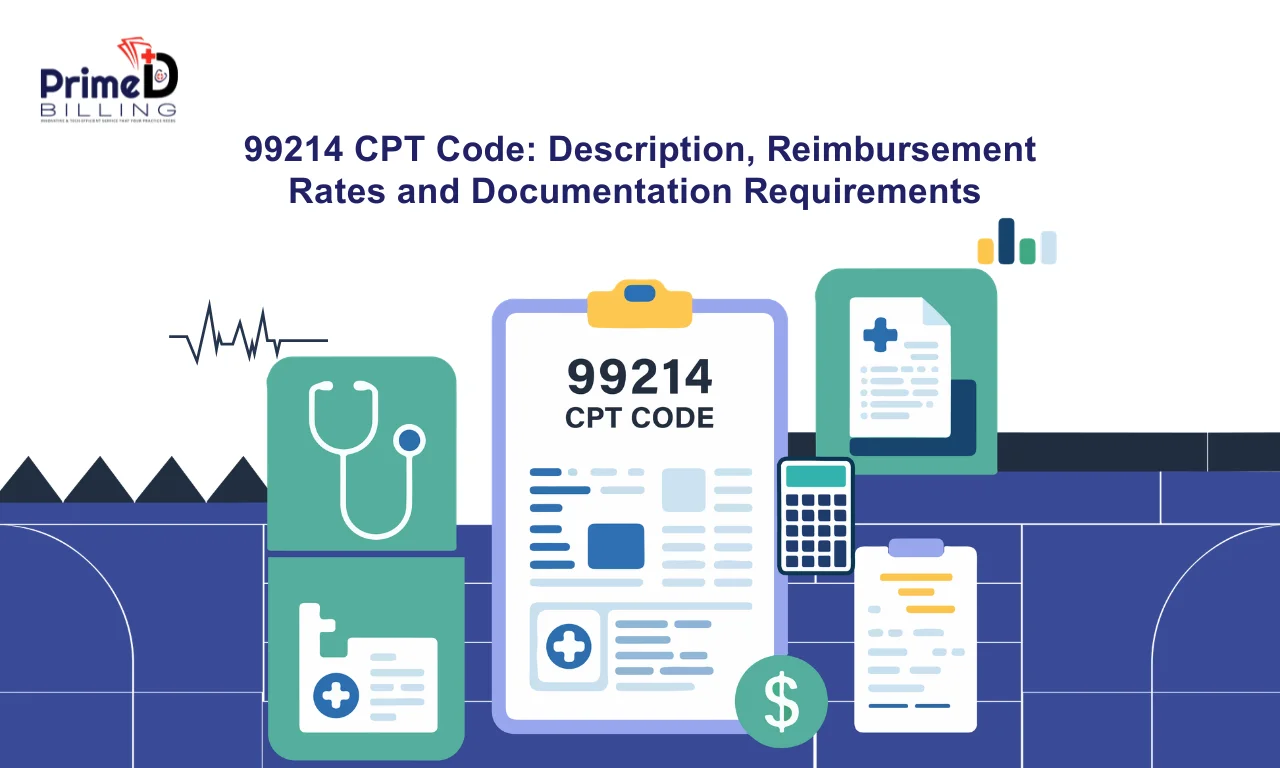
Table of Contents
▼99214 CPT Code: Description, Reimbursement Rates and Documentation Requirements
99214 CPT code is a level 4 E/M service code used for an established patient visit in the provider’s office. CPT 99214 is used when the patient-provider encounter involves moderate Medical Decision Making (MDM) or takes 30-39 minutes of total time. 99214 is commonly used for patients with multiple conditions or worsening symptoms.
CPT 99214 reimbursement rates vary depending on the payer type and setting. Medicare generally reimburses around $126.07 to $143, while the commercial insurers often pay higher rates, ranging from $160 to $220. Medicaid reimbursements vary significantly by state and are usually lower than Medicare. Payments for 99214 CPT codes are calculated using Relative Value Units (RVUs). Accurate medical coding is essential to ensure correct code selection and proper reimbursement.
Proper documentation is essential for accurate reimbursements. The documentation for 99214 needs to support either moderate MDM or time-based billing. The documentations include a detailed medically appropriate history and physical examination of the patient with detailed assessment of the patient’s condition. Strong documentation is important to support medical necessity and ensure compliance to reduce the risks of downcoding or denials.
What is CPT Code 99214?
CPT code 99214 is one of the most commonly used CPT codes in an Evaluation and Management (E/M) coding, used to report outpatient or office visits for an established patient. The patient visit involves moderate-complexity Medical Decision Making (MDM) or 30-39 minutes of total provider time on the date of service.
CPT 99214 is commonly referred to as a Level 4 office visit and is also frequently used in billing for urgent care visits involving moderate-complexity patient evaluation and management. 99214 is used when the patient’s condition requires a high level of clinical evaluation, like managing multiple chronic conditions, reviewing diagnostic tests and making treatment decisions. Proper documentation supporting moderate-level MDM or total time spent ensures accurate reimbursement and supports efficient revenue cycle management.
Which Medical Conditions Commonly Qualify for 99214?
Moderate-complexity cases, that require detailed evaluation, chronic disease monitoring, prescribing medicine, and management of worsening symptoms, are the medical conditions that commonly qualify for CPT code 99214. The clinic visits for such medical cases involve multiple conditions, increased risk to the patient, prescription management, and reviewing labs.
Following are some common medical conditions that are billed under CPT 99214:
- Diabetes with Ongoing Management
- Hypertension with Medication Monitoring
- Chronic Kidney Disease (CKD)
- Asthma or COPD Exacerbation
- Depression or Anxiety Requiring Active Treatment
- Thyroid Disorders
- Congestive Heart Failure (CHF)
- Chronic Pain Management
What are the Common Denials associated with 99214?
Some of the most common denials associated with CPT code 99214 are:
1. Incomplete Medical Decision-Making Documentation
One of the most common denials for CPT 99214 occurs when the medical documentation does not clearly state the moderate-level medical decision making.
2. Errors in Time-Based E/M Coding
When the healthcare providers bill 99214 based on the total encounter time, the documentation needs to clearly state the total time (30-39 minutes) on the day of encounter. Inaccurate or missing time documentation triggers claim denials.
3. Incorrect Modifier Usage and Service Coding Issues
Improper use of modifiers like -25 or incorrect coding combinations increases the risk for claim audits or rejections. Healthcare providers need to review modifier usage to ensure that separately identifiable services are appropriately billed and documented.
4. Failure to Establish Medical Necessity
Claims under CPT code 99214 are often denied when the documentation does not demonstrate why a moderate-complexity clinic visit was medically necessary.
5. Inadequate Documentation of Chronic Conditions
Simple listing of chronic diagnoses without documenting assessment, treatment changes or ongoing management, leads to claim rejections or denials.
What are the Common Mistakes to avoid while using 99214?
Avoiding the following mistakes while using CPT code 99214 helps submit cleaner claims to the insurance payers:
1. Unclear or Generalized Clinical Documentation
The vague or generic use of medical documentations without clearly describing the patient’s condition, provider’s assessment and treatment plan weakens the support for CPT 99214.
2. Omission of Prescription Drug Management Information
Prescription drug management is a major factor that supports the moderate medical decision making for CPT 99214. Failure to document medication adjustments, monitoring, and side effects often results in downcoding or sometimes claim denials.
3. Repetitive or Copied Documentation Practices
Copy pasting previous medical notes without updating the patient’s current condition creates compliance risks and audit concerns for the healthcare providers.
4. Inadequate Description of Patient Problems
Healthcare providers need to clearly document the status, progression and management of each addressed medical condition of the patient to avoid claim denials.
5. Incorrect Use of 99214 for New Patient Visits
CPT 99214 is to be used for established patient office visits only. Using the code 99214 for new patients often leads to claim denials, coding errors or payer compliance issues.
How Does CPT 99214 Affect Revenue Cycle Management?
CPT code 99214 affects Revenue Cycle Management in several ways, including:
1. Revenue Optimization and Leakage Prevention
CPT 99214 helps the healthcare providers ensure appropriate reimbursement for moderate-complexity patient visits. Accurately documented and coded CPT code 99214 prevents underbilling and revenue leakage, allowing healthcare providers to capture full reimbursements for the services provided.
2. Impact on Accounts Receivable (AR) Days
Insurance payers process the clean and accurate 99214 CPT claims faster, which reduces the delays in reimbursement. Therefore, documentation gaps, coding errors, or medical necessity issues often result in resubmissions, increasing the AR days while slowing cash flow of the practice.
3. Documentation Alignment and Integrity
99214 CPT code requires strong alignment between clinical documentations and coding standards. Proper documentation of diagnosis, Medical Decision Making (MDM), treatment plans, and prescriptions ensures coding accuracy while reducing the risk of delayed reimbursement and payer audits.
4. Cash Flow Performance and Stability
Accurate use of 99214 CPT code leads to steady and predictable cash flow by reducing the risk of claim denials or rework. Consistent and compliant coding helps healthcare providers receive the reimbursements on time which improves the overall financial stability for healthcare practices.
5. Audit Risk and Compliance Management
CPT code 99214 claims are often reviewed in payer audits since they are associated with moderate complexity and higher reimbursements. Strong documentation and correct coding practices prevent audit risks and ensure compliance with the CMS and payer-specific guidelines.
What are the Documentation Requirements for CPT 99214?
The documentation requirements for CPT 99214 include a medically appropriate physical examination, along with moderate-level Medical Decision Making (MDM) or qualifying time-based documentation for the patient-provider encounter.
1. Moderate-Level Medical Decision Making (MDM)
Medical Decision Making level refers to the complexity of clinical judgement required for the patient encounter. CPT 99214 involves moderate MDM which typically involves managing multiple conditions, ordering diagnostics, reviewing test results, adjusting medications and assessing a moderate level risk of a patient’s problem.
The documentation needs to clearly show the MDM details including diagnosis, treatment decisions, and clinical reasoning.
2. Time-Based Billing (30–39 Minutes)
CPT 99214 is often billed based on the total provider and patient encounter time which typically ranges from 30 to 39 minutes for established patients. The provider-patient encounter includes patient evaluation, counseling, ordering tests, reviewing records, and documenting the encounter.
Accurate time documentation is the key to proper reimbursement, payer compliance and avoiding claim denials or downcoding.
3. Medically Appropriate History and Physical Examination
The history and physical examination needs to be relevant to the patient’s presenting problems and clinical condition. The clinical documentation of relevant symptoms and physical examination findings is required to be sufficient to support clinical decision-making.
What Type of Medical Decision-Making (MDM) Is Required for 99214?
Moderate-complexity Medical Decision Making (MDM) is required for CPT code 99214. Moderate-complexity MDM refers to the clinical decision making process which involves managing multiple conditions and addressing a moderate level of risk in patient management decisions.
What are the Reimbursement Rates for CPT Code 99214?
The standardized reimbursement rates for CPT code 99214 in the US are categorized as:
1. Medicare National Average Reimbursement
A range of $126.07 to $143 is the Medicare National Average Reimbursement for CPT 99214, based on the 2026 fee schedule projections. Although the exact reimbursement rate varies by geographic locality, regional adjustments, and practice costs.
2. Commercial Payer Reimbursement Rates
Commercial insurers often reimburse at a 115% to 160% higher rate than Medicare. For 99214, the commercial payer reimbursement rate ranges from $160 to $220 and sometimes even more.
3. Medicaid Payment (Varies by State)
The Medicaid approximate reimbursement rate ranges from $69 to $90, however the exact amount depends on each state’s Medicaid fee schedule.
The payment for Medicaid differs significantly by state. Medicaid sometimes pays even 50% to 70% lower than the Medicare rate.
4. Facility vs. Non-Facility Reimbursement Structure
Reimbursement rates for CPT 99214 also differ depending on the location of service. Non-facility settings like private offices typically receive higher reimbursements because of the private expenses. Facility settings, on the other hand, receive lower payments as certain costs are billed separately by the facility.
What are the factors that affect 99214 CPT code reimbursement?
CPT 99214 reimbursements vary based on the complexity of visit, accuracy of supporting documentations, and payer-specific policies for service locations. RVU calculations play an essential role in determining the final reimbursement amount.
1. Geographic Location
Different geographic regions affect the 99214 reimbursement rate because of the CMS Geographic Practice Cost Index (GPCI) adjustments. States or areas with higher practice costs typically receive reimbursements.
2. Payer Type
Each payer reimburses at a different rate. Medicare sets a baseline rate while Medicaid pays a relatively lower rate depending on the state-specific fee schedules. Meanwhile, commercial insurers often pay high reimbursements for 99214 based on the contracts.
3. Place of Service
Reimbursement differs based on whether the services were provided in a non-facility or a facility setting. Non-facility are usually reimbursed higher for 99214 because of the practice overhead costs.
4. Relative Value Units (RVUs)
CPT code 99214 reimbursements are calculated using RVUs. Each 99214 claim is assigned three RVU components; Work RVU, Expense RVU, and Malpractice RVU. The Relative Value Unit acts as a standardized scoring system for 99214 to determine the overall value of medical services.
5. Medical Necessity and Documentation Quality
99214 code claims need to clearly justify medical necessity, moderate-level MDM or time for accurate reimbursements.
What Is the RVU Value of CPT Code 99214?
The RVU value of CPT code 99214 typically ranges from 3.8 to 4.2.
The total RVU consists of three combined components, reflecting physician’s consultation, practice overhead costs, and liability risks.
What Are the Billing Guidelines for CPT Code 99214?
CPT code 99214 is billed for established patient visits to physician’s offices or outpatient visits, involving moderate complexity medical decision making (MDM). If the visit does not meet moderate MDM requirements and supports low-level complexity, it is billed under CPT 99213 instead of 99214.
The total time of encounter under which 99214 is billed ranges from 30 to 39 minutes. The 99214 claim must include medically appropriate history and physical examination documentation at the time of billing.
Is a 99214 Office visit a level 4 visit?
Yes, 99214 CPT code is a level 4 (moderate-level MDM) office visit for an established patient.
What Place of Service (POS) codes can be used with CPT 99214?
CPT 99214 can be best used with POS 11 (office visit) and POS 22 (outpatient hospital visit) depending on the care setting.
Partner with Prime Doc Billing Today
Let our experts handle your billing — streamline your revenue cycle and focus on patient care.