(347) 650-2656
 (347) 650-2656
 info@primedocbilling.com


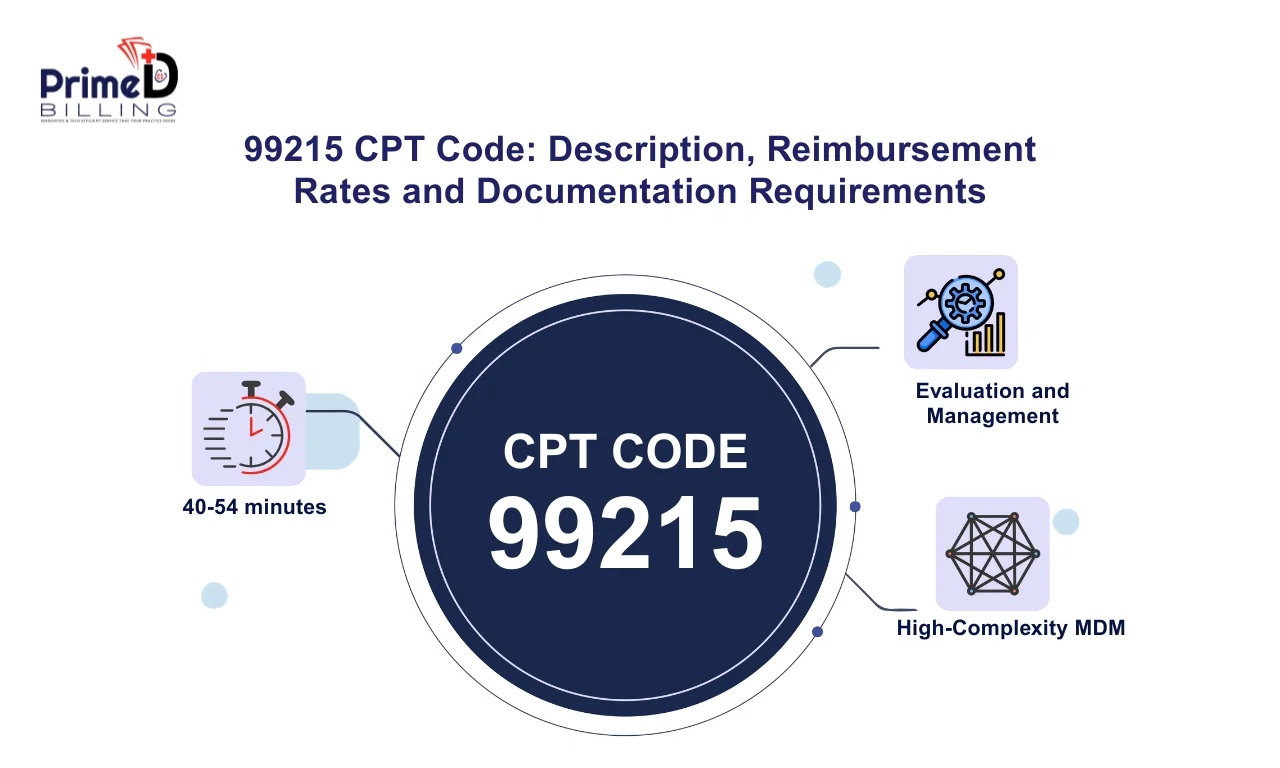
Table of Contents
▼99215 CPT Code: Description, Reimbursement Rates and Documentation Requirements
CPT code 99215 is the highest-level Evaluation and Management (E/M) code in medical coding, used for established patient visits in either provider’s office (non-facility Setting) or outpatient visits (facility Setting). CPT 99215 represents the patient-provider encounters that either require high-complexity Medical Decision Making or takes up the total provider time of 40-54 minutes. The high level of complexity in CPT 99215 codes plays a significant role in the reimbursement structures.
Reimbursement rates for 99215 codes are relatively higher than the low or moderate level E/M codes. The Medicare payments for non-facility settings fall around $192 to $207, while the Medicare reimbursements for facility settings range from $120 to $125. In contrast, commercial insurers pay around $190 to $290 for CPT 99215, which is relatively higher than the Medicare fee schedule. However, accurate reimbursement depends on the proper documentation of high-level medical decision making or total time requirements.
Accurate billing of 99215 codes requires the medical records or documentation to clearly state high-complexity Medical Decision Making (MDM) or 40-54 minutes of total provider time. The documentation requirements includes justifying complex medical conditions, reviewing extensive lab tests, and documenting clinical decision making and risk assessments. Proper documentation is essential to ensure both compliance and accurate reimbursements for high-complexity patient visits.
What is CPT Code 99215?
CPT 99215 code is an Evaluation and Management (E/M) code used to address established patient visits in both facility and non-facility settings. CPT 99215 is one of the most complex CPT codes, which either requires high-complexity Medical Decision Making (MDM) or it is reported when the patient-provider encounter time lies within 40-54 minutes.
The 99215 CPT code is commonly reported for patients with severe diseases, multiple chronic conditions, and acute injuries that pose a threat to the patient’s life or body functions. According to the Medicare utilization data, the high-complexity visits make up only 5-10% of the outpatient E/M services since they require strict clinical documentation requirements and a high-level clinical complexity (Centers for Medicare & Medicaid Services, 2023).
When to Use CPT Code 99215?
CPT code 99215 is only to be used when an established patient (seen by the provider within the last 3 years) is consulted for a high-complexity (high-level Medical Decision Making- MDM) problem that requires extensive and time-consuming care coordination for serious illnesses or diseases.
Which Medical Conditions Commonly Qualify for 99215?
High-complexity cases that require extensive evaluation and management of symptoms, are the medical conditions that commonly qualify for CPT code 99215. The clinic visits for such medical cases involve multiple coexisting medical conditions, increased risk to the patient, complex prescription management, and detailed review of laboratory and diagnostic test results.
Following are some medical conditions that quality for CPT code 99215:
- Uncontrolled diabetes mellitus with complications
- Congestive heart failure exacerbation
- Severe chronic obstructive pulmonary disease (COPD) exacerbation
- Acute kidney injury or advanced chronic kidney disease
- Unstable angina or complex coronary artery disease
- Active cancer requiring ongoing treatment and management
- Sepsis or severe systemic infection requiring close and extensive outpatient management
- Poorly controlled hypertension with end-organ damage
What are the Common Denials associated with 99215?
Some of the most common denials associated with CPT code 99215 are:
- Inadequate Support for Medical Necessity
- Insufficient Evidence of High-Complexity Medical Decision Making (MDM)
- Lack of Total Time Documentation for Time-Based Billing
- Improper Billing of CPT 99215 Without Modifier -25
- Use of Cloned or Repetitive Clinical Documentation
- Excessive Use of CPT 99215 Compared to Practice Benchmarks
What are the Common Mistakes to avoid while using 99215?
Following are the few common mistakes to avoid while using 99215:
1. Failing to Justify High Patient Risk
Healthcare practices need to avoid documenting 99215 without the supporting documentation of high patient risk or the severity of patient’s illness. Failure to justify high patient risk in 99215, leads to insurers either downcoding the claim to 99214 or completely denying it.
2. Overstating the Severity of the Condition
One of the most common mistakes to avoid while submitting 99215 claims is overstating the severity of diagnosis since the auditors rely on supporting clinical data (abnormal labs or imaging findings) to verify high-complexity medical decision making (MDM).
3. Missing Total Time Documentation
A key problem occurs when the medical claims are submitted without accurately documenting the total provider-patient encounter time. Vague statements like ‘30 minutes spent’ without total time breakdown should also be avoided.
4. Inconsistent E/M Level Selection Across Similar Clinical Visits
Healthcare providers need to avoid using inconsistent patterns for similar patient encounters, like billing some of them as 99214 while the rest as 99215, without clinical justification.
5. Using 99215 for New Patients
Using CPT 99215 for patients who are new to the provider or practice, is one of the most common mistakes in medical billing. It results in the non-compliance with CPT classification rules, leading to increased audit risk.
How Does CPT 99215 Affect Revenue Cycle Management?
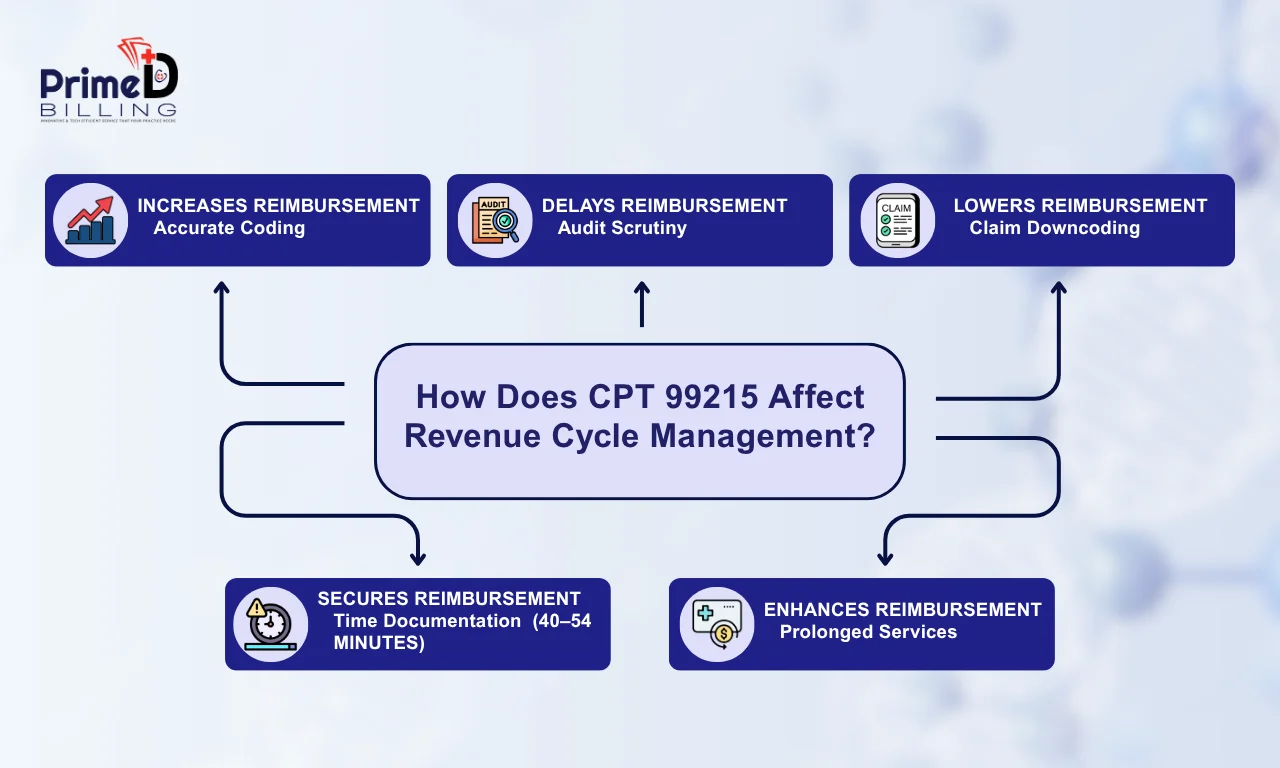
Since CPT 99215 represents the highest level of established patient visits, it plays a significant role in revenue optimization and payer reimbursement patterns. Following are the most prominent ways of CPT 99215 affecting healthcare revenue cycle management:
1. Impact of Accurate 99215 Coding on Revenue Optimization
Accurate CPT 99215 coding directly improves the net revenue capture and reimbursement accuracy of the practices in RCM. Accurate documentation of 99215 ensures full payment capture of the physician’s high complexity care coordination.
2. Compliance Risks and Audit Exposure in 99215 Billing
CPT 99215 being a high value code is specifically targeted in payer audits because of the upcoding compliance risks. Insurance companies use AI-based audit tools to detect whether there is an unusually high usage of CPT 99215, which results in delayed reimbursements and prepayment audits.
3. Revenue Loss Due to Claim Downcoding and Underpayment
Incomplete or missing documentation to support medical necessity often leads to downpayment from 99215 to 99214, which leads to a significant revenue leakage or underpayments.
4. Importance of Proper Time Documentation in RCM
Time based billing for CPT 99215 requires strict documentation of total provider encounter time, which ranges from 40-54 minutes. Accurate time tracking validates higher-level billing eligibility to ensure timely reimbursements.
5. Role of Prolonged Service Codes in Increasing Reimbursement
When the patient visit in high-complexity MDM cases increases the given time limit of 40-54 minutes, the providers need to use prolonged service codes to capture additional reimbursement. For example, CPT 99417 represents the prolonged outpatient E/M time.
What are the Documentation Requirements for CPT 99215?
CPT 99215 code represents the highest-level established patient office visit, so the documentation needs to clearly support either high-complexity medical decision making (MDM) or the specified total provider encounter time (40-54 minutes).
1. Medical Decision Making (MDM)
In case of using medical decision making for medical necessity justification, the documentation needs to clearly state high complexity MDM by showing:
- One or more illnesses with serious progression. (current condition status)
- Acute or chronic illness posing serious life threat (clinical impact and urgency)
- Multiple comorbid conditions affecting management (relationship between multiple conditions
- Lab results (specific values)
- Imaging studies (CT, MRI)
- External medical records
- Medications requiring intensive monitoring
- Clinical Decision making regarding hospitalization
2. Total Time (40–54 Minutes)
99215 medical claims are also submitted based on the total provider time on the date of service. The documentation needs to specifically include:
- Clearly stated total time (40-54 minutes)
- Breakdown of total time into sections like chart review, documentation, care coordination, face to face evaluation, and patient counseling.
- Compliance with the rule that the services were personally performed by the physician rather than the staff or nurses.
3. Additional Required Documentation Elements
In order to ensure 99215 compliance, the documentation or medical records needs to clearly include:
- Patient status (established- seen within 3 years)
- Chief complaint (clear reason for encounter)
- Assessment and Plan (problem, assessment, treatment decision, medication changes)
- Clinical reasoning (provider though process and alternatives consideration, if any)
- Data specification (exact reviewed tests, results, interpretation, external records)
- Care coordination (communication with specialists, referrals)
What Type of Medical Decision-Making (MDM) Is Required for 99215?
High-complexity Medical Decision Making (MDM) is required for CPT code 99215. High-complexity MDM refers to the provider’s management of medically high-risk complex conditions that requires extensive evaluation, diagnostics analysis, and treatment decisions carrying a prominent risk of complications.
What are the Reimbursement Rates for CPT Code 99215?
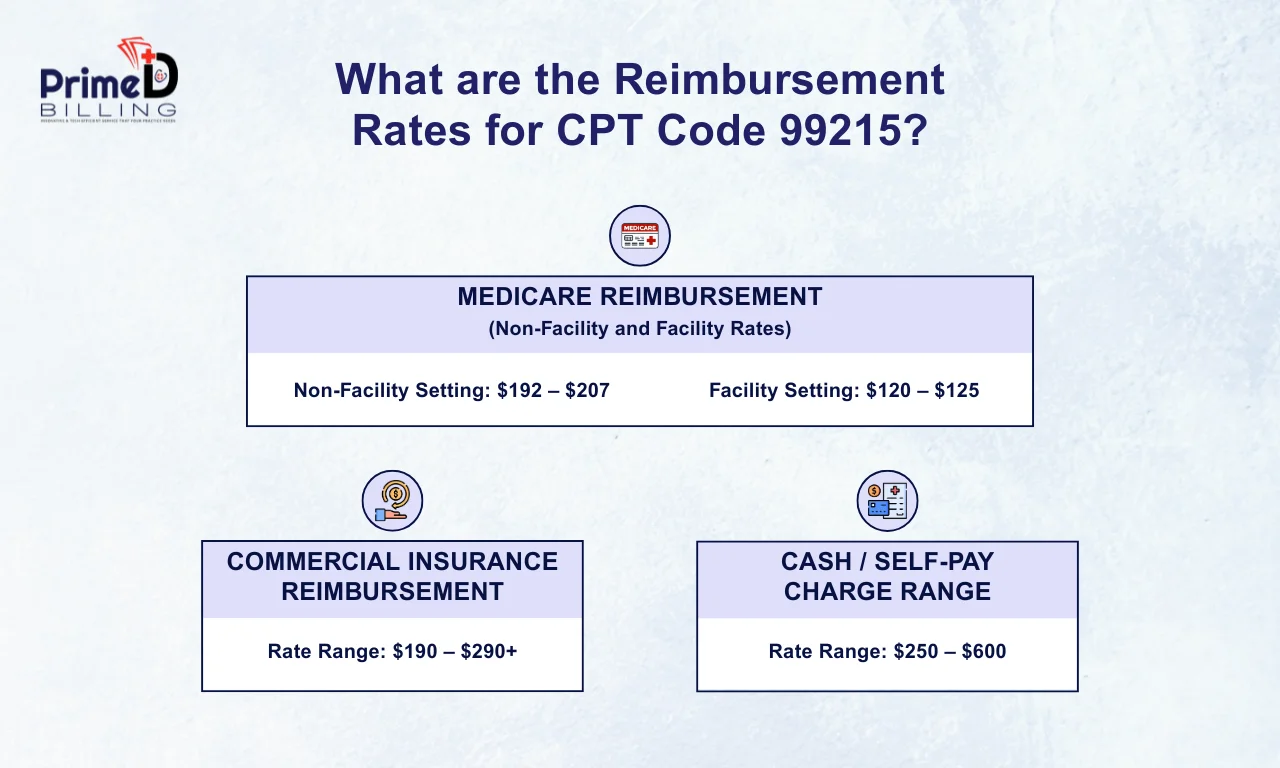
The reimbursement rates for CPT code 99215 falls within $160 – $300 which is an average range, depending on the location, payer type, and facility or non-facility setting.
1. Medicare Reimbursement (Non-Facility and Facility Rates)
Medicare assigns two different reimbursement rates for CPT code 99215 depending on the setting where the services were performed:
Non-Facility Setting
The approximate reimbursement of non-facility providers ranges from $192 to $207, as reported in the year 2026. Medicare pays a higher non-facility reimbursement rate to cover the staffing, equipment, and operational costs for private physician offices or clinics.
Facility Setting
Providers are reimbursed at an approximate rate of $120 to $125 in a facility setting. Medicare pays a relatively lower professional fee to hospital outpatient departments as compared to non-facility settings since the facility separately bills for its overhead costs and resources.
2. Commercial Insurance Reimbursement
The reimbursement rate for commercial insurers ranges from $190 to $290 and above. However the reimbursement range entirely depends on the negotiated contracts between healthcare providers and commercial payers. Highly negotiated contracts sometimes exceeds the range of $290.
3. Cash / Self-Pay Charge Range
Self-pay charges commonly range from $250 to $600, since there is no standardized fee for the patients paying out-of-pocket for their rendered medical services.
What are the factors that affect 99215 CPT code reimbursement?
Following are some of the most common factors that affect 99215 CPT code reimbursement:
- Insurance Payer and Contracted Fee Schedule
- Geographic Location and Medicare GPCI Adjustments
- Documentation of Medical Decision Making (MDM) or Total Time
- Place of Service (Office vs Facility Setting)
- Patient Complexity and Risk of Management
What Is the RVU Value of CPT Code 99215?
2.80 is the standardized Work RVU value for CPT code 99215, in both facility and non-facility settings.
However the total RVU value for CPT 99215 is the sum of combined Work RVU, Practice Expense RVU, and Malpractice RVU. Even though the work RVU stays the same in both facility and non-facility settings, the Practice Expense (PE) RVU and Malpractice RVU differ in both.
Facility Setting
Work RVU = 2.80
Practice Expense RVU = 0.65 (approx)
Malpractice RVU = 0.31 (approx)
Total Relative Value Unit = 3.76 (approx)
Non-facility Setting
Work RVU = 2.80
Practice Expense RVU = 2.48 (approx)
Malpractice RVU = 0.48 (approx)
Total Relative Value Unit = 5.76 (approx)
What Are the Billing Guidelines for CPT Code 99215?
CPT code 99215 is billed for established patient visits in both facility and non-facility settings, involving high complexity medical decision making (MDM). If the patient visit does not meet high MDM requirements and supports low-level or moderate-level complexity, it is billed under CPT code 99213 or 99214, respectively, instead of 99215.
The total time of patient-provider encounter under which 99215 is billed ranges from 40 to 54 minutes. The 99215 CPT claim must include documentation related to either high-complexity MDM or total provider time (40-54 minutes) to avoid claim delays or denials.
References
Centers for Medicare & Medicaid Services. (2023). Medicare physician/supplier utilization and payment data. http://www.cms.gov
Partner with Prime Doc Billing Today
Let our experts handle your billing — streamline your revenue cycle and focus on patient care.