(347) 650-2656
 (347) 650-2656
 info@primedocbilling.com


Table of Contents
▼Healthcare EDI: Meaning, Transactions and Benefits
EDI stands for Electronic Data Interchange which is the standardized electronic communication between healthcare providers, insurance payers, and clearinghouses, to exchange healthcare information. EDI enables healthcare organizations to share administrative, financial, and clinical data in a secure, accurate, and consistent manner, built on standards established by ANSI X12, which are regulated under HIPAA. The standardized communication is made possible through a variety of EDI transactions, designed to support specific billing functions.
Healthcare EDI operates through a series of standardized transaction sets in the Revenue Cycle Management (RCM) process. The EDI transactions include patient eligibility verification, provider enrollment, healthcare claims submission, claim status inquiries, payment and remittance advice, prior authorizations, and coordination of benefits, each following a specified electronic format to minimize manual intervention. By automating these clinical workflows, EDI delivers several operational and financial advantages to the healthcare practices.
EDI offers significant operational and financial benefits to the healthcare organizations like accelerating claim processing and reimbursements, reducing administrative workload and claim errors, strengthening regulatory compliance, enhancing data security, and supporting real-time communication between healthcare stakeholders. EDI helps healthcare providers create a more connected and reliable healthcare ecosystem.
What is EDI in healthcare?
Electronic Data Interchange in healthcare refers to the exchange of standardized administrative and financial information between healthcare providers, insurance payers, and clearinghouses. The information exchange is based on transaction standards developed by the ANSI X12, which operated under regulations set by HIPAA.
The ANSI X12 and HIPAA’s standardized formats ensure secure, consistent, and structured transmission of healthcare data, regardless of the type of software and technology used by healthcare entities. EDI enables faster reimbursements, greater interoperability, and efficient revenue cycle process management across the healthcare industry.
How is EDI used in healthcare?
EDI usage in healthcare is defined in the following steps:
1. Converting healthcare data into standardized EDI files
The first step includes converting clinical and billing information from healthcare systems into structured Electronic Data Interchange (EDI) formats like EDI 837.
2. Transmitting EDI files to payers and clearinghouses
After the EDI files are created, they are electronically sent either directly to the insurance payers or through the clearinghouses.
3. Validating EDI data for accuracy and format compliance
After transmission, the receiving system checks the EDI files for errors, missing information, and compliance issues defined by ANSI X12.
4. Exchanging structured request and response transactions
After EDI validation, the system proceeds to process and communicate the transaction between healthcare entities. The payer system processes the request and generates a structured electronic response, confirming acceptance, rejection, or requiring additional information.
5. Routing transactions through clearinghouse networks
After the payer system generates a response, the transaction is sometimes routed through a clearinghouse network. The clearinghouse ensures that the payer’s response is correctly formatted and linked to the original request.
6. Automatically posting responses into healthcare systems
After receiving the claim status updates or payment advice from the payers, they are automatically posted into the healthcare provider’s billing system to reduce manual data entry errors and speed up financial reconciliation.
7. Maintaining a continuous electronic processing cycle
Electronic Data Interchange operates as an ongoing cycle where healthcare data is continuously created, transmitted, and validated to ensure uninterrupted communication across the healthcare Revenue cycle management process under HIPAA compliance.
What is the Importance of EDI in Healthcare?
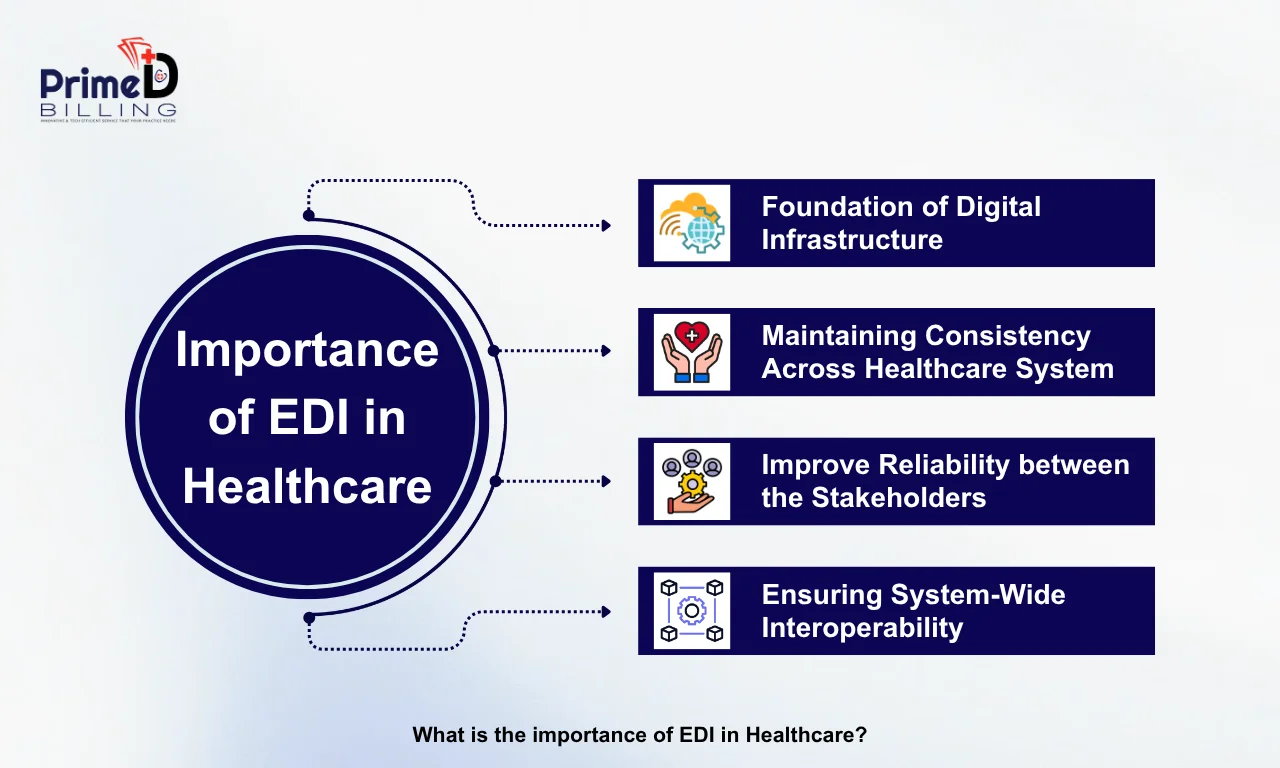
Following are the most significant importance points of EDI in healthcare:
Foundation of Digital Healthcare Infrastructure
Electronic Data Interchange (EDI) acts as the backbone of digital healthcare infrastructure by enabling an automated and structured data exchange between healthcare providers and insurance payers.
Maintaining Consistency Across Healthcare System
EDI ensures all healthcare stakeholders use a uniform and consistent format for exchanging healthcare information like claims, eligibility data, and reimbursements, to help reduce confusion and interpretation errors.
Improving Reliability between Providers, Payers, and Clearinghouses
EDI strengthens trust and reliability among healthcare entities by reducing communication gaps and ensuring a smoother financial and administrative coordination in the healthcare ecosystem.
Ensuring System-Wide Interoperability
EDI allows multiple healthcare information systems to communicate seamlessly with the standardized transaction sets defined by ANSI X12 without any compatibility issues.
What is a healthcare EDI Parser?
A healthcare EDI parser is a software tool that reads, interprets, and converts Electronic Data Interchange (EDI) transactions into a structured, simple, and human-readable format.
Healthcare organizations use EDI to automate the exchange of data between providers, insurance payers, clearinghouses, and billing systems to eliminate the need for manual interpretation of complex EDI files, while accelerating reimbursement by enabling seamless system integration
What is EDI validation?
EDI validation is the process of verifying the accuracy for an Electronic Data Interchange (EDI) transaction, while ensuring it to be complete, correctly formatted, and compliant with industry standards before it is accepted for claim processing.
EDI validation reduces claim rejections, improves data accuracy, speeds up reimbursements, supports regulatory compliance, and lowers administrative costs of the practice, by serving as a quality control step for successful claim processing.
How is EDI Validated?
EDI validation works in the following steps:
- Syntax Validation- The system checks whether the file follows correct segment structure and HIPAA compliant formats to ensure structural integrity.
- Data Element Validation- The billing software then checks patient demographics, coding, payer IDs, and required insurance details for accuracy.
- HIPAA and Payer Rule Validation- The claim is tested for compliance and payer specific rules to avoid audit risk.
- Business Rule Validation- This step detects any diagnosis and procedure mismatches and duplicate claims to avoid claim denials.
- Pre-Adjudication Checks- The claim often passes through a scrubber system to flag potential denial risks, while suggesting corrections before sending the claim to the clearinghouse.
- Clearinghouse Validation- The clearinghouse performs final EDI checks to either accept or reject the claim before forwarding it to the payer.
What are EDI Transactions in healthcare?
Healthcare EDI (Electronic Data Interchange) transactions are standardized digital messages that are defined under ANSI X12 HIPAA standards. Healthcare EDI transactions enable the secure exchange of clinical, administrative, and financial data between providers, payers, and clearinghouses to support end-to-end Revenue Cycle Management (RCM) of the practices.
Provider Enrollment & Credentialing
The healthcare providers use EDI 834 for provider enrollment and credentialing processes, where provider information like licenses, certifications, and practice details are electronically shared with insurance payers. EDI transactions enable the providers’ onboarding more faster, accurate, and standardized across insurance networks.
Patient Access & Eligibility
Healthcare practices use EDI 270/271 transactions to verify patient eligibility and insurance benefits before providing services to the patients.
The real-time EDI exchange refers to the provider sending an eligibility inquiry (EDI 270) to the payer, and the payer responding with coverage details (EDI 271), such as active insurance status, deductibles, co-pays, and plan benefits, while reducing claim denials by confirming coverage in advance.
Claims Management
EDI 837 is used by healthcare providers to submit medical claims electronically to insurance companies for reimbursement. The EDI 837 transaction includes detailed information regarding patient diagnosis, procedures, and billing code, helping the providers ensure faster claim submission, reduced errors, and improved claim processing speed compared to manual claim submission.
Coordination of Benefits (COB)
Coordination of Benefits (COB) in healthcare is supported through multiple EDI transactions, like EDI 837 for claim submission and EDI 835 for payment processing. EDI ensures that the claims are correctly routed between primary and secondary payers to help determine which insurer pays first and how the remaining balances are supposed to be reimbursed.
Attachments & Supporting Documentation
EDI attachments like NCPDP or X12 275 transactions are used by healthcare providers to send documentations like medical reports, charts, and clinical notes along with the claims. The attached documents help the insurance payers validate medical necessity of services provided to help improve first-pass acceptance rate of the medical claims.
Claim Tracking & Adjudication
Healthcare practices use EDI 276/277 to track claim status after submission. The claim tracking works by providers sending a claim status inquiry (EDI 276) to the payers and the insurance payers responding (EDI 277) with updates like received, under review, approved, or denied, helping providers handle their revenue cycle more efficiently.
Error Handling & Rejection Management
EDI acknowledgment transactions like EDI 997 or 999 are used by healthcare providers to identify errors in claims submitted to the payers. The EDI responses notify providers with the reasons for denial, which can be either due to the formatting or missing information. The error handling and rejection management of EDI helps providers improve clean claim rates.
Payments & Administration
EDI 835 is used by healthcare providers to receive electronic payments and remittance advice from insurance payers. EDI 835 includes detailed payment information like approved amounts, adjustments, and denial reasons, allowing providers to reconcile payments automatically while reducing manual workload from the practice staff.
System Acknowledgments
EDI system acknowledgment transactions are used by healthcare practices to confirm whether the submitted data is successfully received by the payer systems. The EDI system confirmations ensure that no data is lost during transmission, while helping the providers maintain trust with payers in electronic workflows.
Reporting & Analytics
Healthcare providers use EDI data to generate reports and analytics on claim performance, reimbursement trends, and denial patterns. The structured analytics help healthcare organizations improve revenue cycle efficiency of the practice.
What is the HIPAA EDI Rule?
The HIPAA EDI Rule is a set of regulations under Health Insurance Portability and Accountability Act (HIPAA) that requires healthcare organizations to use standardized Electronic Data Interchange (EDI) formats, particularly ASC X12 Version 5010 for EDI transactions and NCPDP for pharmacy data.
Why does HIPAA-compliant EDI matter?
HIPAA-compliant EDI matters because:
- HIPAA EDI ensures all electronic healthcare data exchange follows a standardized communication between providers, payers, and clearinghouses, ensuring secure, accurate, and consistent information flow.
- EDI formats defined by ANSI X12 reduce errors caused by mismatched systems while speeding up claim processing.
- HIPAA compliance ensures that the sensitive patient information is protected during transmission to maintain data privacy while preventing unauthorized access.
What are the benefits of EDI healthcare?
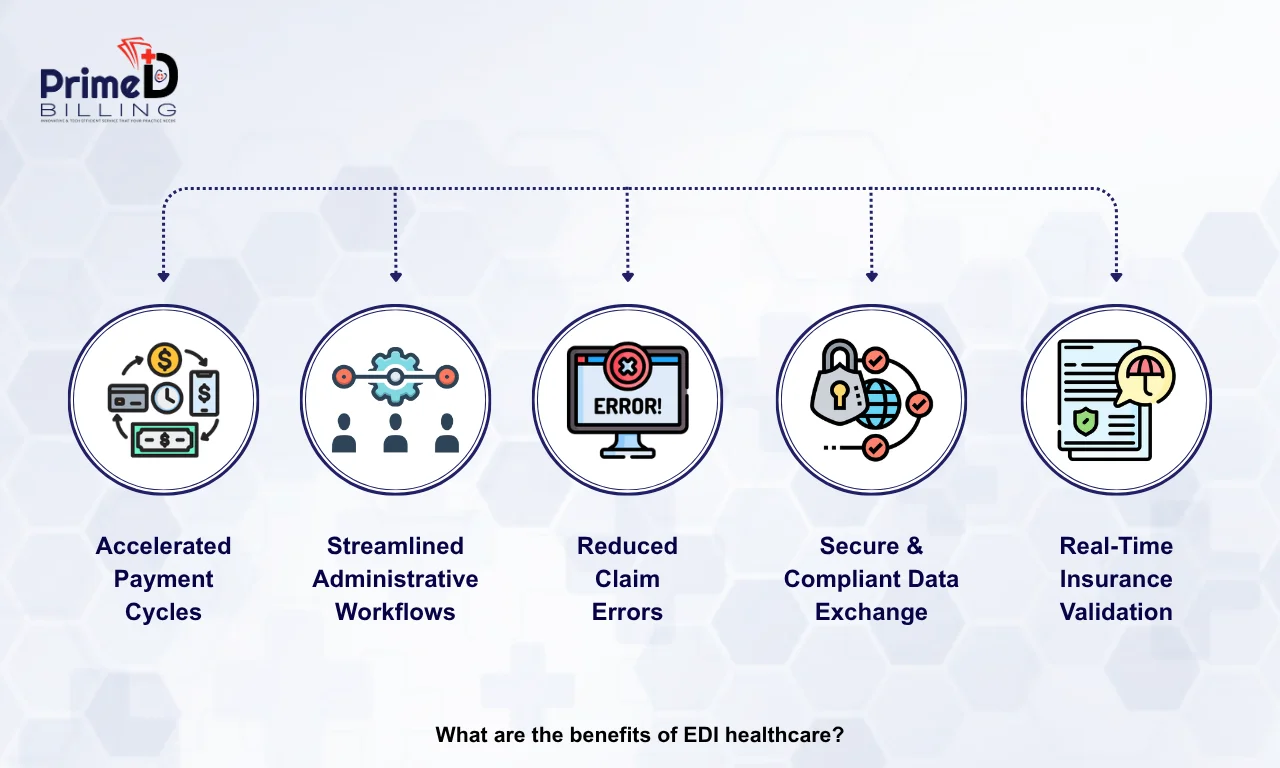
Electronic Data Interchange (EDI) provides multiple benefits by streamlining electronic data exchange between providers, payers, and clearinghouses to ensure security, accuracy, and overall efficiency of the Revenue Cycle Management (RCM) process.
Accelerated Payment Cycles
EDI enables healthcare providers to submit electronic claims through EDI 837 transactions, resulting in faster claim processing by insurance payers. EDI 835 also speeds up payment cycles by reporting quick reimbursement results to the healthcare providers.
Streamlined Administrative Workflows
EDI minimizes manual paperwork and staff workload by automating tasks, like insurance eligibility checks (EDI 270/271), prior authorizations (EDI 278), and claim status inquiries (EDI 276/277), to improve overall revenue cycle management efficiency of the practice.
Reduced Claim Errors
The standardized transaction formats and validation rules in EDI reduces data entry mistakes, lowers claim rejection rates, and minimizes costly denials, by ensuring accurate transmission of patient demographics, and CPT, ICD-10, and HCPCS codes.
Secure & Compliant Data Exchange
Healthcare EDI transactions are heavily encrypted and exchanged only through secured networks, to help healthcare organizations comply with HIPAA regulations while safeguarding Protected Health Information (PHI).
Real-Time Insurance Validation
Healthcare providers instantly verify a patient’s insurance coverage, copayments, deductibles, and benefit limitations by using EDI 270/270 eligibility transactions. Real-time verification helps prevent billing issues and improve the patient’s financial experience.
What is the role of EDI in RCM?
Electronic Data Interchange plays a crucial role in Revenue Cycle Management (RCM) by acting as a digital communication backbone which connects the financial and administrative workflows between payers, providers, and clearinghouses under ANSI X12 and HIPAA compliance rules.
Partner with Prime Doc Billing Today
Let our experts handle your billing — streamline your revenue cycle and focus on patient care.

COB in Medical Billing: Definition, Importance, and Rules
August 7, 2026
Timely Filing Limits in Medical Billing
July 7, 2026
Claim Adjudication: Definition, Process and Outcomes
June 28, 2026