(347) 650-2656
 (347) 650-2656
 info@primedocbilling.com


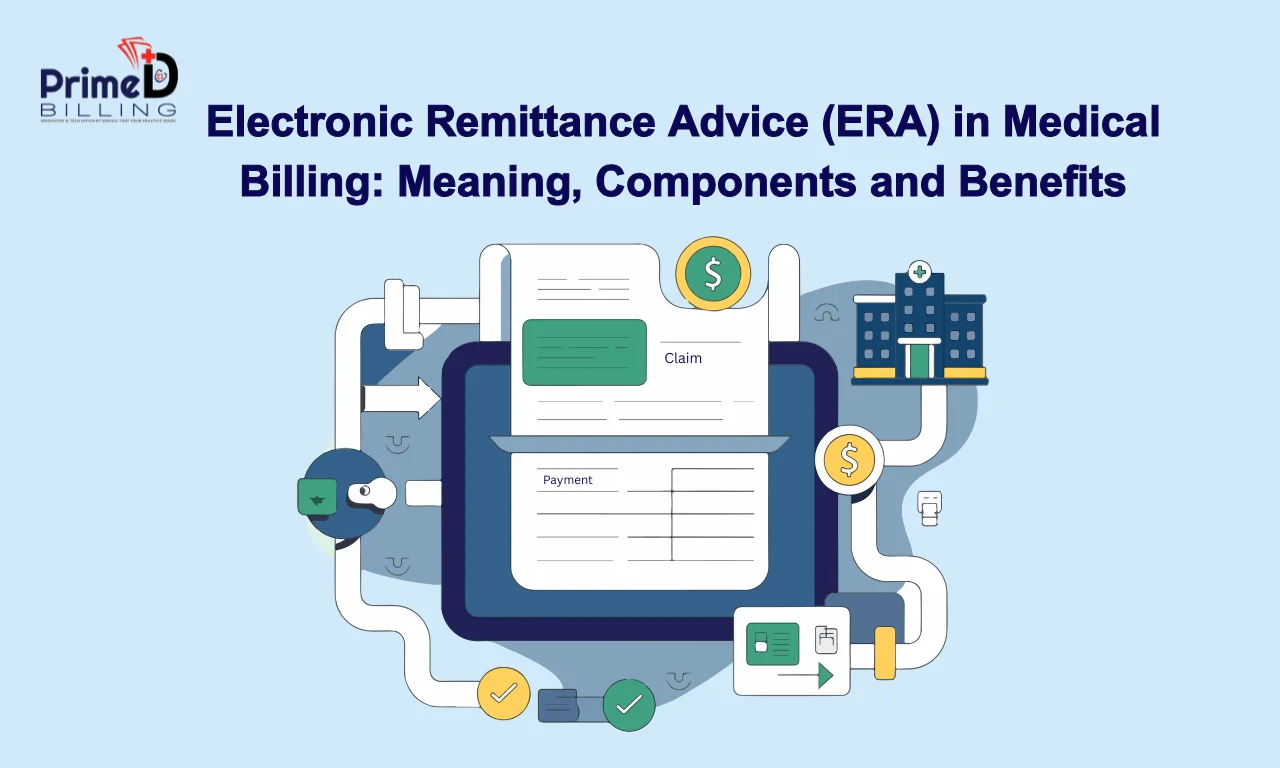
Table of Contents
▼Electronic Remittance Advice (ERA) in Medical Billing: Meaning, Components and Benefits
Electronic Remittance Advice in medical billing is an electronic document used to explain how the insurance payer processed a medical claim and how the payments were applied. Insurance companies send ERA to the healthcare providers once the claim has been adjudicated. ERA is transmitted using ANSI X12 835 format and it contains detailed information about payments, adjustments, and denials.
Electronic Remittance Advice (ERA) helps the healthcare providers understand the outcomes of a claim while supporting efficient payment reconciliation within healthcare revenue cycle management (RCM). The claim outcomes are presented through structured components of the ERA which includes payer and provider details, patient and subscriber information, service line breakdowns, payment amounts and adjustment codes. These components of ERA help explain denials, reductions, and the patient responsibility.
ERA provides significant benefits in the medical billing process by streamlining the entire payment and reconciliation process. ERA enables faster payment posting, improved operational efficiency by minimizing paper-based work, allowing the billing staff to focus more on claim resolution and revenue cycle management.
What is Electronic Remittance Advice (ERA) in Medical Billing?
Electronic Remittance Advice (ERA) is a standardized digital communication to explain how the insurance payer processed the medical claim and calculated the payment. According to the Centers for Medicare & Medicaid Service (CMS), standardized electronic transactions like ERA are designed to improve administrative efficiency and reduce manual billing overhead in healthcare systems.
The industry research shows the impact of ERA on operational efficiency. The healthcare revenue reports indicate that electronic claim payment system and automation lowers administrative processing time by up to 60-80% as compared to paper-based workflows in large scale organizations (CAQH Index, 2022–2024 estimates).
What Key Details does an ERA have?
Following are the key details an ERA (Electronic Remittance Advice) has:
Payer Information
The payer information section is used to identify the insurance company that processed the claim. Details including payer name, payer ID, and contact details are crucial for routing payments accurately. The payer details also helps the billing team identify which payer-specific regulations and reimbursement policies were applied.
Payment Summary
Payment summary provides a detailed overview of the transactions, including total billed amount, allowed amount, paid amount, and the patient’s responsibility. The patient’s responsibility section consists of deductible, copay, or coinsurance.
The payment summary section in Electronic Remittance Advice (ERA) gives a quick overview of how much revenue was expected and how much was received.
Provider Information
The provider information contains details about the healthcare organization that receives the payment. The identifiers included in the ERA’s provider information are NPI, tax ID, and the provider name. Accurate provider data is essential for organizations with multiple healthcare providers.
Patient & Subscriber Information
This section in the ERA identifies the patient who received medical care and the subscriber who holds the insurance policy. The distinction between these two entities is different because the insurance benefits are determined based on the subscriber’s coverage rather than the patient.
Claim Overview
The claim overview is the summary of each processed claim, including necessary details like date of service, total charges, and overall claim status. The claim overview section in the ERA helps the billing team identify whether the claim was successfully processed or needs follow-up.
Service Line Breakdown
The service line breakdown in ERA is the in-depth analysis of a medical claim. The following sections include details like CPT, ICD-10, and HCPCScodes, units of service, billed amount, allowed amount and paid amount. The details help the medical billers identify underpayments, coding issues, or discrepancies between expected reimbursement and received payment.
Adjustment Explanation
The Adjustments section in the ERA explains why the billed amount differs from the amount paid. Adjustments are represented using standardized codes like RARCs (Remittance Advice Remark Codes) and CARCs (Claim Adjustment Reason Codes) to indicate the reasons for contractual write-offs, bundling, non-covered services, or missing data.
How does the ERA Process Work in Medical Billing?
The ERA process in medical billing works in the following key steps:
Claim Submission
The Electronic Remittance Advice (ERA) process begins when a healthcare provider submits a medical claim to the insurance payer. The medical claim is considered a request for payment from the insurance payers after delivering medical services to the patients.
Claim Adjudication
The medical claim goes through the adjudication process after the insurance payer receives it from the healthcare provider. Claim adjudication is the internal review process of a medical claim where the insurer verifies patient eligibility, coverage, medical necessities, coding accuracy and policy rules. Based on the internal review, the claim is either denied, approved, or partially paid.
Electronic Remittance Advice (ERA) Generation
After the claim adjudication process, the insurance payer generates an Electronic Remittance Advice (ERA), typically in the 835 EDI format to explain how the claim was processed. The ERA includes payment details, adjustments, and denial reasons, which is securely transmitted back to the provider electronically.
Payment Posting
The healthcare providers’ billing system automatically or manually post payments after receiving ERA (Electronic Remittance Advice). The payment posting process ensures that the payments are matched to the correct claims. The medical billers also record allowed amounts and payer reimbursements to determine patient’s responsibility.
Payment posting ensures accurate financial reconciliation in the healthcare organization’s revenue cycle process.
Denial Management
If the Electronic Remittance Advice shows any denied claims, the billing team identifies the reason for denial using RARC (Remittance Advice Remark Codes) and CARCs (Claim Adjustment Reason Codes). The billing team corrects coding errors, provides missing information, and resubmits claims to the insurance payer. Denial management is crucial for minimizing revenue loss and improving the overall financial health of the practice.
Patient Billing
After the insurance payments and adjustments, the remaining balance becomes the patient’s responsibility. The medical billing team uses ERA data to generate patient statements to ensure accurate billing for non-covered services.
What are the Key Benefits of ERA in Medical Billing?
Some of the most common key benefits of ERA in medical billing are:
Faster Payment Posting
ERA automates the payment posting process by integrating remittance data directly into the medical billing systems instead of entering EOB details manually. Payments are posted instantly, which reduces the turnaround times and improves overall cash flow of the practice.
According to industry reports, automation in payment posting improves processing efficiency by up to 70–90%, while reducing manual data entry errors by nearly 50%.
Increased Operational Efficiency
ERA eliminates the need for repetitive manual tasks like data entry and claim matching. ERA helps the medical billers handle high volumes of claims in lesser time with minimal errors. ERA allows the staff to focus on more high-value tasks like revenue optimization and denial resolution.
Reduced Costs
ERA reduces administrative overhead by minimizing the use of printing, scanning, and manual labor. Electronic Remittance Advice leads to significant savings in the medical billing operations and process while improving overall financial efficiency.
Improved Denial Management
Electronic Remittance Advice provides standardized denial reason codes, like CARC and RARC which helps the billing team instantly identify why the claim was denied or underpaid. The standardized denial coding leads to faster root cause analysis, more effective appeal strategies, and better tracking of the denial trends.
Better Compliance & Audit Readiness
ERA uses standardized HIPAA compliant 835 format to ensure consistent and traceable payment documentation. The digital recording of payment transactions reduces compliance risks and supports accurate financial reporting during internal or external audits and payer reviews.
What is the Difference between ERA and EOB?
Electronic Remittance Advice |
Explanation of Benefits |
|
Format |
ERA uses a structured and standardized electronic format ANSI X12 835 for system integration and automation. | EOB uses a human-readable PDF document or paper format which is usually not structured for system use. |
Audience |
The audience for Electronic Remittance Advice are healthcare providers, medical billing teams, and practice management systems. | EOB’s audience typically includes patients, but they are also accessible to the providers for reference. |
Purpose |
The purpose of ERA is to communicate payment details, adjustments, and claim processing for payment posting and reconciliation. | The purpose of EOB is to explain to the patients how the claim was processed and the balance due on patients. |
Speed |
ERA is delivered quickly via electronic transmission, within a few hours of sometime a few days. | The speed for EOB delivery is relatively slow as it mainly depends on printing and mailing, or in some cases delayed digital delivery. |
Processing |
ERA is the automated process of payment posting into the billing systems. | EOB is the manual review of claim payment details. |
What are the Core Similarities between ERA and EOB?
Electronic Remittance Advice and Explanation of Benefits both serve the same purpose of explaining how a medical claim was processed by the insurance payer. ERA and EOB contains the reason for denial to explain the difference between billed and paid amount, enabling patients and healthcare providers to understand claim outcomes instantly.
Frequently Asked Questions
1. What is the difference between an ERA and an EFT?
| ERA (Electronic Remittance Advice) | EFT (Electronic Funds Transfer) | |
| Purpose | ERA provides detailed payment information to healthcare providers. | EFT is the transfer of actual payment funds. |
| Content | ERA includes claim details like CPT, ICD-10 codes, adjustments, patient information, and denials. | EFT contains financial transaction data like amount, date, and account information. |
| Format | ERA is usually in the ANSI X12 835 format. | EFT is in the banking format (ACH – Automated Clearing House transfer transaction). |
2. How to read an ERA?
To read an ERA, start with verifying provider and payer information, reviewing payment summary, checking the claim details, analyzing service, procedure, payment details, and conclude with interpreting adjustment codes (CARC/RARC) to understand the reason for claim rejections or denials.
3. How to convert EOB to ERA?
EOB can not be directly converted into ERA since ERA is generated electronically by the insurance payer in the standardized 835 format. However, it is possible to manually enter EOB data into the billing system.
4. How is payment posting done using ERA in medical billing?
Payment posting is usually done by automatically importing ERA files into the billing system where payments, adjustments, and denials are matched with the corresponding claims.
5. What are the most common ERA codes and adjustments in medical billing?
The most common ERA and adjustment codes in medical billing are CARC (Claim Adjustment Reason Code) and RARC (Remittance Advice Remark Code). CARC explains why the payment was reduced and RARC provides any additional context.
6. How are claim denials identified and handled using ERA?
Claim denials are identified using CARC and RARC codes in the ERA. The process of identifying claim denials begins with reviewing denials codes and reasons. The medical billers categorize denials according to their reasons and correct issues to resubmit the claim to the insurance companies.
7. How has ERA evolved in medical billing over time?
ERA has evolved from paper-based remittance (EOBs) to fully electronic and standardized formats. The ANSI X12 835 format was introduced to ensure consistency, and integration with practice management systems was implemented to enable seamless automation and efficient processing.
References
Centers for Medicare & Medicaid Services. (2023). Electronic health care transactions and code sets standards. U.S. Department of Health & Human Services.
Council for Affordable Quality Healthcare (CAQH). (2022–2024). CAQH index report: Administrative simplification in healthcare. CAQH.
Wager, K. A., Lee, F. W., & Glaser, J. P. (2021). Health care information systems: A practical approach for decision making (5th ed.). Jossey-Bass.
Kellermann, A. L., & Jones, S. S. (2013). What it will take to achieve the as-yet-unfulfilled promises of health information technology. Health Affairs, 32(1), 63–68.
Partner with Prime Doc Billing Today
Let our experts handle your billing — streamline your revenue cycle and focus on patient care.

COB in Medical Billing: Definition, Importance, and Rules
August 7, 2026

Timely Filing Limits in Medical Billing
July 7, 2026

Claim Adjudication: Definition, Process and Outcomes
June 28, 2026