(347) 650-2656
 (347) 650-2656
 info@primedocbilling.com


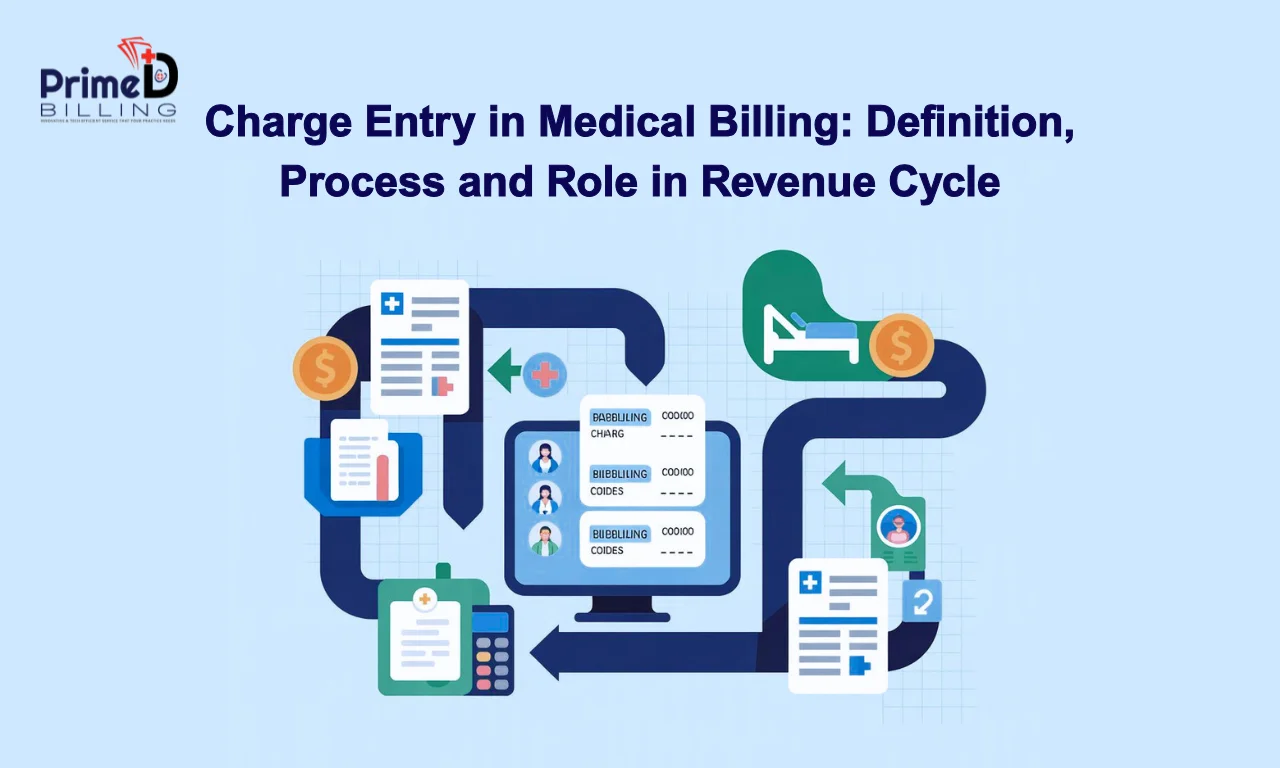
Table of Contents
▼Charge Entry in Medical Billing: Definition, Process and Role in Revenue Cycle
Charge entry in medical billing refers to the process of entering coded clinical services into billable data to create charges for the insurance companies. The billable data is used for the insurance claim generation to get reimbursement for the services provided to the patients.
Charge entry begins after medical billing professionals carefully enter date of service, fee schedules, CPT, ICD-10, and HCPCS codes along with the patient and provider demographics into the EHR. The medical billers review the provided data for accuracy before claim generation. The charge entry data is then used to create claims, which are scrubbed for errors before final submission to the payers for accurate reimbursement.
Charge entry acts as an essential bridge in the Revenue Cycle Management (RCM) process between recorded clinical documentation and claim submission. Charge entry ensures accurate conversion of healthcare services into financial data for cleaner claim submissions and timely reimbursements.
What is Charge Entry in Medical Billing?
Charge entry is the process of entering clinical documentation into the billing system to create reimbursable charges. Charge entry includes adding patient and provider details, CPT, ICD-10, and HCPCS codes, modifiers and the provider’s fee amount to prepare the claim for submission.
Charge entry occurs after the clinical services are documented and coded by medical billing professionals. Charge entry usually occurs within 48 hours after the date of the service provided to the patients. Delays in charge entry lead to slower claim processing and reduced cash flow for the practice.
What are the Core Components of Charge Entry?
The core components of charge entry are:
- Patient demographics (patient’s name, address, date of birth, insurance details, policy number)
- Provider information (provider name, National Provider Identifier- NPI, insurance facility details)
- Date of service (exact date when the service was provided to the patient)
- Medical codes (CPT, ICD-10, and HCPCS codes)
- Modifiers (additional details for procedures like multiple services)
- Fee information (amount based on payer contracts and fee schedules)
- Diagnosis-procedure linkage (connecting diagnosis codes with procedures for justifying medical necessity)
- Referral numbers or Authorization (necessary documentation required for insurance authorization)
What is the Step by Step Process of Charge Entry?
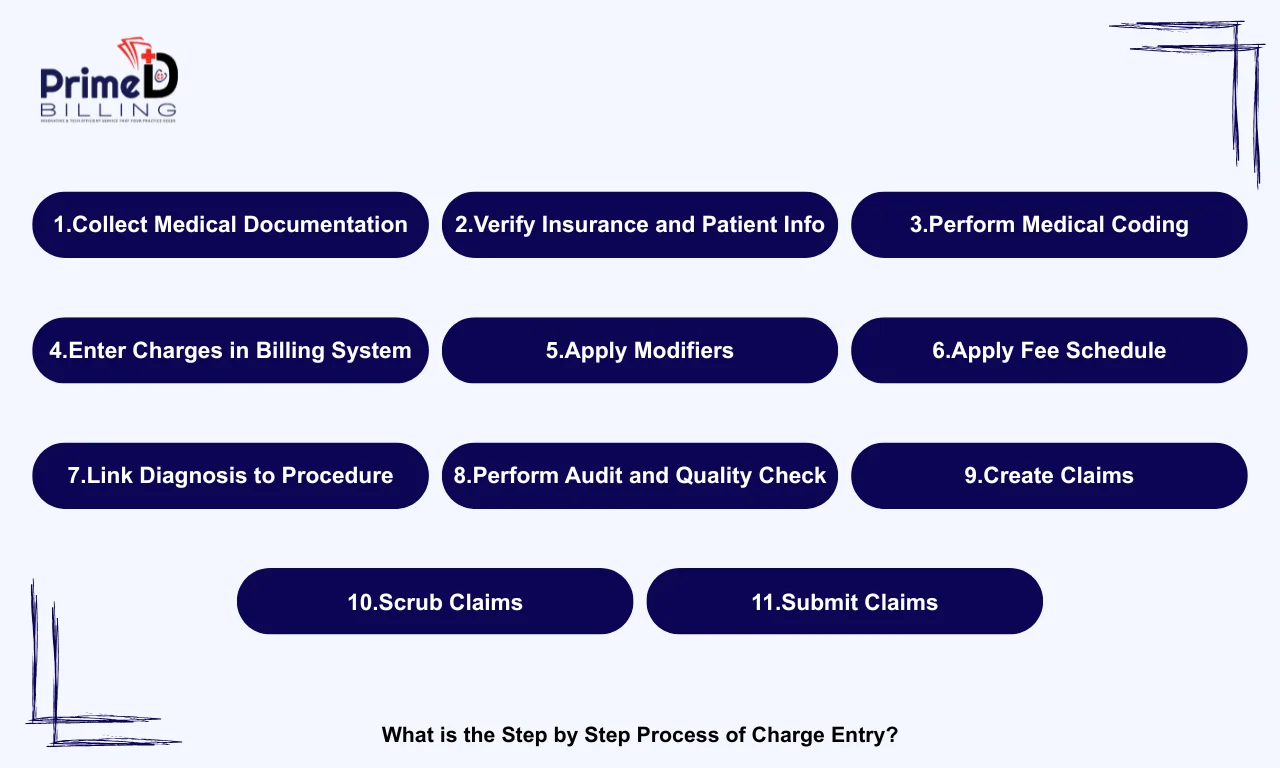
The step by step process of charge entry is:
1. Collect Medical Documentation
The medical billers collect all the necessary medical documentation before charge entry to ensure accurate record of every service. The relevant medical documentation includes physician notes, encounter forms, and lab reports.
2. Verify Insurance and Patient Information
The verification of patient and provider information is the most crucial step in charge entry. The patient demographics like name, address and date of birth and the insurance details including payer name, eligibility and insurance policy number helps ensure the patient is active in the insurance coverage system.
The medical billers also verify referrals and authorizations in this step, if required.
3. Perform Medical Coding
This step involves converting documented medical services into standardized medical codes. The CPT, ICD-10, and HCPCS accurate coding reflects compliance with the insurance guidelines to help prevent audits and denials.
4. Enter Charges in the Billing System
The entire medical information coding is entered into the billing systems and softwares to create medical claims. The coded medical information also includes assigned fees from the provider’s fee schedule.
5. Apply Modifiers
Modifiers are applied to give any additional information necessary for charge capture. The additional medical information about the services include bilateral procedures, multiple procedures, technical components or professional components. Correct use of modifiers ensures proper reimbursement for the rendered services.
6. Apply Fee Schedule
The charges that are assigned based on the payer contract rates ensures consistency with the agreed pricing. Incorrect free schedule results in underpayments or compliance issues.
7. Link Diagnosis to Procedure
Linking diagnosis code to the procedure code justifies medical necessity of the procedure. This step is crucial to give valid diagnosis to the insurance payers to get accurate reimbursements.
8. Perform Audit and Quality Check
An internal audit is essential to catch errors like incorrect patient or provider details, missing codes, mismatched diagnosis-procedure links, or invalid modifiers. Performing audit and quality check reduces the risk of claim rejections while improving accuracy.
9. Create Claims
After the completion of charge entry, the billing system takes all the entered charges and groups them in an insurance claim format. The billing system assigns claim numbers and creates an actual claim from charge entry.
10. Scrub Claims
The medical billers run the claim through scrubbing tools and clearinghouses to check for errors and formatting issues. The claim scrubbing also identifies issues in payer-specific requirements to correct before final submission.
11. Submit Claims
The clean and finalized claims are submitted electronically either to the clearinghouses first or directly to the insurance payers. Once the claims are submitted, the medical billers track it for rejection or further processing.
What is the Role of Charge Entry in RCM?
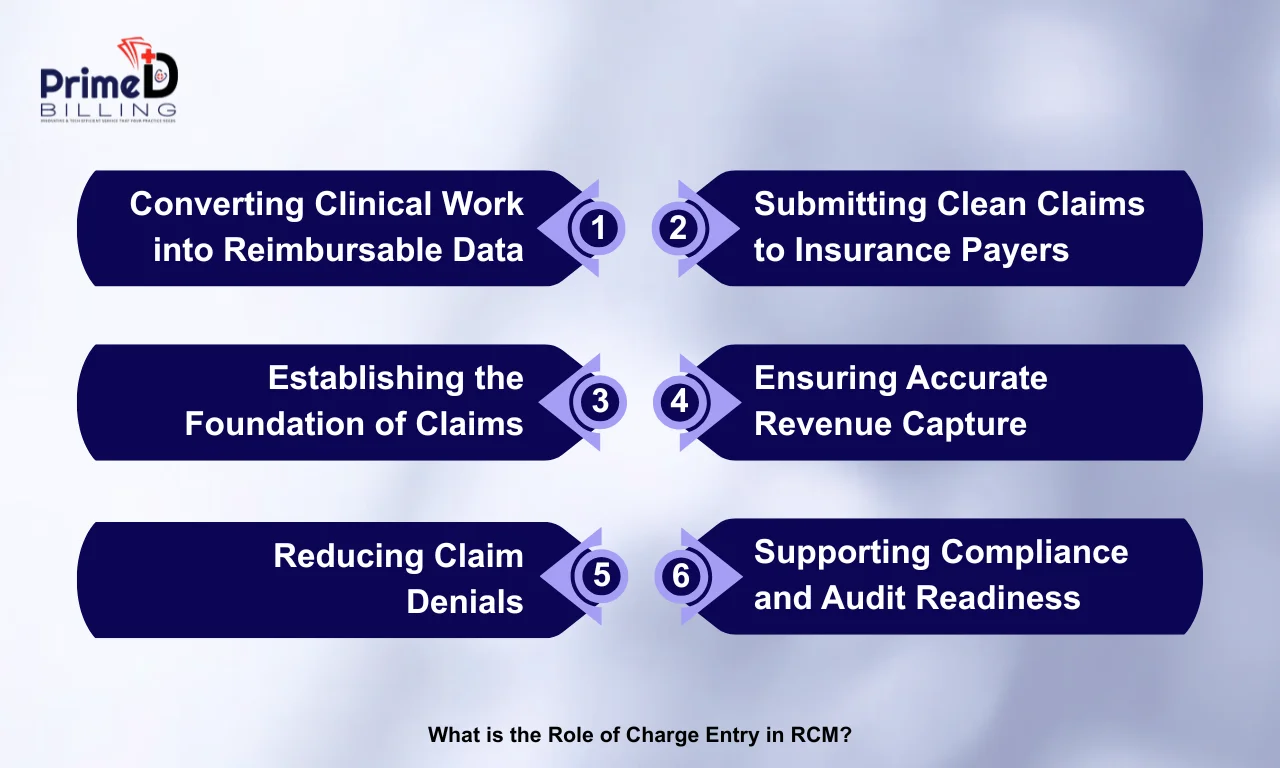
Some of the most common roles of charge entry in the Revenue Cycle Management (RCM) are:
1. Converting Clinical Work into Reimbursable Data
Charge entry translates medical procedures and physician notes into standardized codes and billable charges. The conversion of clinical services into financially reimbursable data ensures accurate charge capture within the Revenue Cycle Management (RCM) process
2. Submitting Clean Claims to Insurance Payers
Accurate charge entry in RCM ensures clean claims with minimal errors, leading to higher first-pass acceptance rate. Clean claims ensure faster reimbursements from the insurance payers.
3. Establishing the Foundation of Claims
Charge entry acts as the foundation of claims by organizing all coded services and charges into structured data in the RCM workflow.
4. Ensuring Accurate Revenue Capture
Precise charge capture in the RCM ensures accurate capture of each rendered service. Accurate revenue capture prevents revenue leakage and supports complete reimbursement for the healthcare providers.
5. Reducing Claim Denials
Accurate charge capture in RCM helps minimize claim denials by reducing the risk of errors in coding, modifiers, and diagnosis linkage.
6. Supporting Compliance and Audit Readiness
Proper charge capture ensures alignment of billing data with clinical documentation, making the claim audit ready within RCM. The medical billers also review payer regulations to strengthen compliance for the claim.
Who is Responsible for Charge Entry?
Following are the personnel or organizations responsible for charge entry in medical billing:
1. Medical Billers
Medical billers are primarily responsible for the charge entry process. Healthcare organizations hire external medical billing companies to enter coded medical data into billing softwares to prepare the data for claim creation and submission.
2. Certified Coders
Certified coding experts assign accurate CPT, ICD-10, and HCPCS codes to the rendered services based on medical documentation. Medical coding is essential to ensure accurate charge entry and support compliant and error-free claim submission within RCM.
3. Provider’s Front-Desk Staff
In smaller practices, the front desk staff often performs basic charge entry tasks before submitting them to medical billers for final claim processing. The basic charge entry tasks include entering patient information, encounter forms and visit details.
4. External RCM Companies
Many healthcare organizations outsource their charge entry process to specialized external RCM companies. These RCM companies have a dedicated team of medical billers and coders who handle charge entry by ensuring accuracy and compliance in the medical billing process.
What are the Compliance and Regulations for Charge Entry?
Following are they key compliance and regulatory requirements for charge entry in RCM:
1. Ensuring Proper Documentation Support
Every charge entered in the billing system is supported by complete clinical documentation. The necessary data in clinical documentation includes physician notes, lab reports, and encounter details, justifying medical necessity for rendered services. Incomplete or unclear documentation often leads to compliance issues, claim rejections and denials.
2. Maintaining Coding Accuracy
Accurate assignment of CPT, ICD-10, and HCPCS codes are essential for the charge entry process. The medical codes need to reflect the services provided to the patients. Any inconsistency in coding leads to claim rejections or revenue loss for the practice.
3. Achieving Audit Readiness
Charge entry needs to be performed in a way that all the medical documentations and records are well-organized and accurate. Accuracy in medical coding ensures that the organization is able to justify billed services if an internal or external audit takes place.
4. Complying with NCCI Edits and Modifier Usage
Charge entry needs to abide by National Correct Coding Initiative (NCCI) edits to avoid coding inaccuracies. Modifiers are essential to apply in case of special circumstances for accurate billing of provided services.
5. Following Payer-Specific Guidelines
Different insurance companies have unique billing requirements including modifier usage, and authorization rules. Charge entry needs to be aligned with payer-specific guidelines in order to maximize first-pass acceptance rate.
6. Ensuring HIPAA Compliance
Every medical data and record handled during charge entry needs to comply with HIPAA (Health Insurance Portability and Accountability Act) rules and regulations. HIPAA compliance includes securing patient sensitive information, maintaining confidentiality, and preventing unauthorized access.
7. Meeting Timely Filing Requirements
Timely and efficient charge capture helps avoid claim rejections that occur due to late filing. Timely filing ensures the charges are entered right after the date of service and the corrections are completed within the given timeframe.
What are the Common Errors in Charge Entry?
Some of the most common errors in charge entry are:
1. Incorrect Patient Data
Incorrect patient data like name, address, date of birth, or insurance ID often leads to claim denial or rejections, or even causes a mismatch with the payer records.
The best way to avoid inconsistencies in patient information is to verify patient demographics and details against insurance registration data. The use of eligibility tools before charge entry helps prevent claim denials due to incorrect patient data.
2. Duplicate Charge
The errors related to duplicate charges occur when the same service is entered more than once for the same patient. Duplicate charges often lead to overbilling and claim rejections if submitted to the insurance payers.
Checking patient account history before entering new charges helps detect duplicate billing. Claim scrubbing also helps avoid duplicate charge, which often leads to compliance issues.
3. Wrong Date of Service
One of the most common errors occurs when the date entered in the system does not match with the actual date of the service present in medical documentation.
Cross verifying the date of service with the patient’s EMR records helps avoid the errors related to incorrect date of service.
4. Missing Modifiers
Modifiers are essential to explain additional circumstances of a medical procedure. Missing modifiers leads to claim denials or reduced payments from the insurance companies.
Maintaining a reference guide for commonly used modifiers and using payer-specific guidelines for modifier application helps prevent the errors related to missing modifiers.
5. Coding Errors
Coding errors occur when the providers use mismatched, outdated or incorrect CPT, ICD-10, and HCPCS codes in charge entry. Coding errors in charge entry results in underpayment or compliance issues.
Ensuring regular training of medical coders and staying up-to-date with the coding guidelines helps prevent coding errors in the charge entry process.
What are the Tools and Softwares for Charge Entry?
Some of the most basic tools and softwares for charge entry are:
1. Electronic Health Record (EHR) Systems
Electronic Health Record systems are used to access clinical documentation and enable real-time charge capture from the patient encounters. Following are the most common EHR systems in medical billing:
- Cerner
- eClinicalWorks
- Epic Systems
- Athenahealth
- Practice Fusion
2. Practice Management (PM) Systems
Practice Management systems in medical billing are used to manage patient registration, scheduling, and billing workflows. Following are the top examples of Practice Management systems:
- Kareo
- NextGen Healthcare
- eClinical Works
- PracticeSuite
3. Revenue Cycle Management (RCM) Platforms
Revenue Cycle Management platforms provide end-to-end billing workflows for the practice. RCM platforms usually include analytics, automation and denial management tools. Following are some of the most widely used RCM platforms in medical billing:
- MEDITECH
- Epic
- Optum
- athenahealth
4. Clearinghouse Softwares
Clearinghouse softwares are used to detect inconsistencies before claim submission. Clearinghouses also helps ensure compliance with the payer-specific guidelines and requirements. The most commonly used clearinghouses softwares are:
- Availity
- Change Healthcare
What are the Best Practices to Optimize Charge Entry?
Following are the best practices to optimize charge entry in the RCM process:
1. Implement Automated Charge Entry Systems
Automation in charge entry requires the use of EHR software to capture charges directly from the clinical documentation. Automated charge capture reduces turnaround times while improving accuracy and clean claim rates.
2. Maintain Accurate Clinical Documentation and Coding
Maintaining accurate documentation and proper coding ensures the services are translated into billable data correctly. This is one of the most crucial steps of charge entry, as it directly impacts claim accuracy, reimbursement and overall efficiency of the revenue cycle.
3. Perform Early Insurance Eligibility Verification
Verifying insurance eligibility early ensures that the patient’s coverage is active. Early insurance verification helps prevent claim denials related to coverage limitations, missing authorizations, or inactive policies.
4. Conduct Regular Charge Entry Audits
Routine internal audits help identify discrepancies like incorrect codes, missing charges and modifier issues. The internal charge entry audits help prevent revenue leakage of the practice by correcting the mistakes beforehand.
5. Standardize Charge Capture Processes
Using standardized workflows for charge entry ensures consistency while reducing variability within billing staff. Capturing the required billing information consistently is considered one of the best practices for charge capture.
6. Monitor Key RCM Performance Metrics
Tracking Key Performance Indicators (KPIs) like accounts receivables and denial rates helps resolve bottleneck issues and identify areas that need improvement.
7. Provide Ongoing Staff Training and Development
Continuous training ensures the billing staff stays updated with the payer rules and coding updates related to charge entry. Well-trained billing staff helps reduce claim errors and improve overall charge entry efficiency.
How does Prime Doc Billing help in Accurate Charge Entry?
Prime Doc Billing ensures accurate charge entry by using standardized workflows and advanced billing softwares. Our team carefully reviews clinical documentation and ensures correct use of CPT, ICD-10 and HCPCS coding before entering the charges into the system.
We focus on minimizing manual mistakes and submit timely charge entries to increase first-pass acceptance rates to achieve more accurate and faster reimbursement. Our proactive comprehensive approach leads to cleaner claim submissions and reduced denial rates to improve overall financial performance of the healthcare practices.
Frequently Asked Questions
1. What is the difference between charge entry and medical coding?
| Charge Entry | Medical Coding | |
| Definition | Charge entry refers to the entering of coded medical data into the billing systems and softwares. | Medical coding refers to the conversion of clinical documentation into standardized codes. |
| Function | Charge entry is the process of putting codes with charges, and modifiers. | Medical coders assign CPT, ICD-10, and HCPCS codes to the billable services. |
| Role in RCM | Charge entry prepares medical data for claim creation and submission. | Medical coding ensures correct representation of the services provided. |
2. What is charge lag?
Charge lag is the delayed time frame between the date a medical service is provided to the patients and the date the charge is entered into the billing system. Lower charge lag results in quicker reimbursement for the practice.
3. What are charge entry services?
Charge entry services are a part of the medical billing process where trained medical billing professionals review and enter clinical documentation into the billing systems to create charges for insurance claims.
4. What is charge capture?
Charge capture is the record of all billable services provided to the patients for reimbursement. Charge capture ensures that every service and procedure is ready to be converted into charges.
Partner with Prime Doc Billing Today
Let our experts handle your billing — streamline your revenue cycle and focus on patient care.

COB in Medical Billing: Definition, Importance, and Rules
August 7, 2026

Timely Filing Limits in Medical Billing
July 7, 2026

Claim Adjudication: Definition, Process and Outcomes
June 28, 2026