(347) 650-2656
 (347) 650-2656
 info@primedocbilling.com


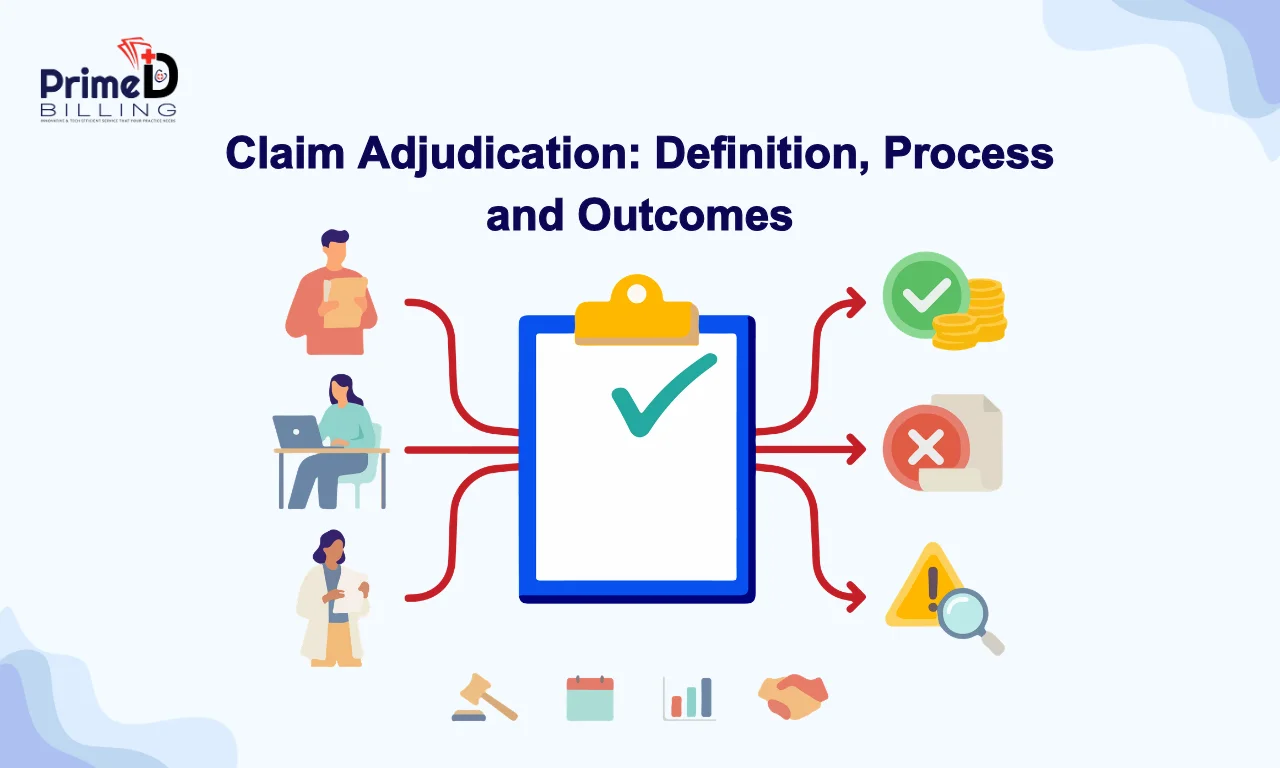
Table of Contents
▼Claim Adjudication: Definition, Process and Outcomes
Claim Adjudication begins after a patient receives healthcare services and the provider submits a medical claim to the insurance payer. The insurance payer then reviews the claim for eligibility, coverage, coding accuracy, and medical necessity before making a payment decision.
Claim Adjudication refers to the decision-making process used by healthcare insurers to examine a medical claim submitted by the healthcare providers. The insurance providers determine how a claim needs to be processed under the terms of the patient’s health plan. According to the Centers for Medicare & Medicaid Services (CMS), claims processing involves reviewing submitted claims to ensure that services are covered, properly coded, and medically necessary under program rules (CMS.gov, Medicare Claims Processing Manual).
The claim adjudication consists of five key steps that the insurance payers follow to evaluate and finalize a submitted medical claim. The process begins with an initial review of the submitted details and documentation, followed by an eligibility and coverage check to confirm active insurances and benefits. The insurers then review payer-specific and coding guidelines to validate CPT, ICD-10, and HCPCS accuracy. The medical necessity assessment ensures that the services were clinically appropriate. The four steps conclude the claim’s final outcome where the claim is either approved, partially paid, denied, or placed on hold.
The outcomes of a claim adjudication determine how a medical claim was processed and paid by the insurance payer based on the coding accuracy, medical necessity, and state-specific guidelines. Each outcome, whether approved, partially paid, denied, rejected, or pending review, directly impacts the provider’s reimbursement and the patient’s financial responsibility. The payment decisions ensure that the claims are handled in a structured and consistent manner while maintaining compliance with the HIPAA guidelines and state-specific policies.
What is Claim Adjudication?
The process of reviewing claims to determine payment is called Claim Adjudication. The Claim Adjudication is a formal process used by healthcare insurance companies or payers to review, evaluate and decide the final outcome of a medical claim submitted by the healthcare providers. Based on the evaluation, the medical claim is either approved, partially approved, denied, rejected, placed in a pending status or adjusted.
The National Council for Prescription Drug Programs (NCPDP) defines adjudication as the process of evaluating a claim transaction to determine the financial responsibility of both the payer and the patient (NCPDP.org)
What are the 5 steps involved in the Claim Adjudication Process?
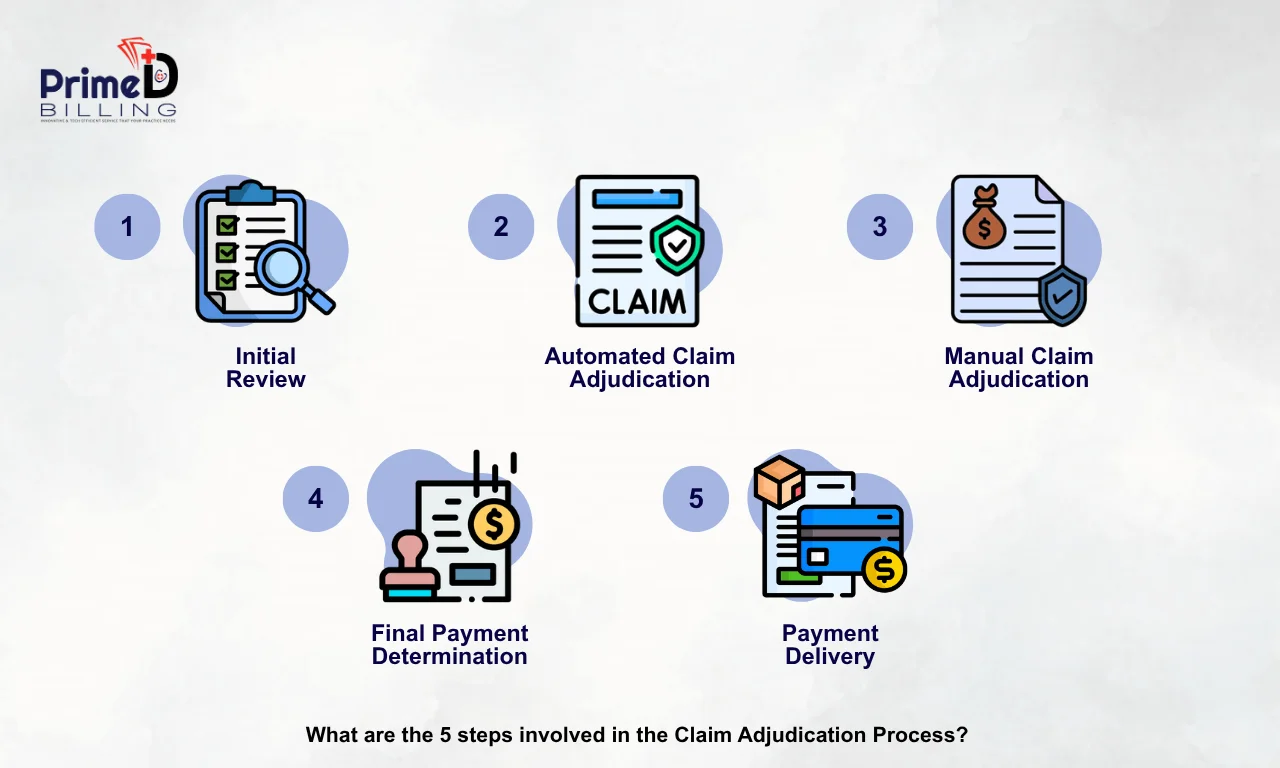
The claim adjudication process consists of the steps an insurance company or payer takes to evaluate and determine the final outcome of a submitted claim. Following are the five steps in the claim adjudication process:
1. Initial Review
The claim adjudication process begins with an initial review of the claim submitted to the insurer. The payer confirms whether all the required information, including patient demographics, provider details, diagnosis codes, procedure codes, and supporting documentation, is included in the medical claim. Claims with missing or incorrect information are rejected and returned to the providers for correction before further processing.
2. Automated Claim Adjudication
In automated claim adjudication, the insurance payer uses software to review claims electronically. The payer system checks the medical claim for patient eligibility, coverage, coding accuracy, and compliance policies, ensuring quick processing for clean claims.
The automated claim adjudication helps insurers handle large numbers of claims and flag out any complex issues that need further manual review.
3. Manual Claim Adjudication
If the automated claim adjudication raises a flag, the claim moves for a manual review. Manual claim adjudication involves a detailed review of medical records, coding accuracies, supporting documentation, and medical necessity to ensure accurate reimbursements, while avoiding errors like duplicate billing.
Based on the manual adjudication, the claim is either processed further or declared pending for additional information before making a final payment determination.
4. Final Payment Determination
Once the claim is thoroughly reviewed, it is either approved for full payment, partially paid with adjustments, or denied.
The insurance payer calculates the exact payable amount according to the patient’s benefits and provider’s contractual agreement.
5. Payment Delivery
The final step in the claim adjudication process is payment delivery to healthcare providers, where insurance payers issue reimbursement based on the adjudication outcome. The insurers then generate either Explanation of Benefits (EOB) or Electronic Remittance Advice (ERA) to send the claim outcome to healthcare providers and explain any payment reductions or denial reasons.
The healthcare providers then post the payment to the patient’s account and bills the patient for any remaining deductible, copayment, or coinsurance to complete the claim reimbursement cycle.
What are the Outcomes of Claim Adjudication?
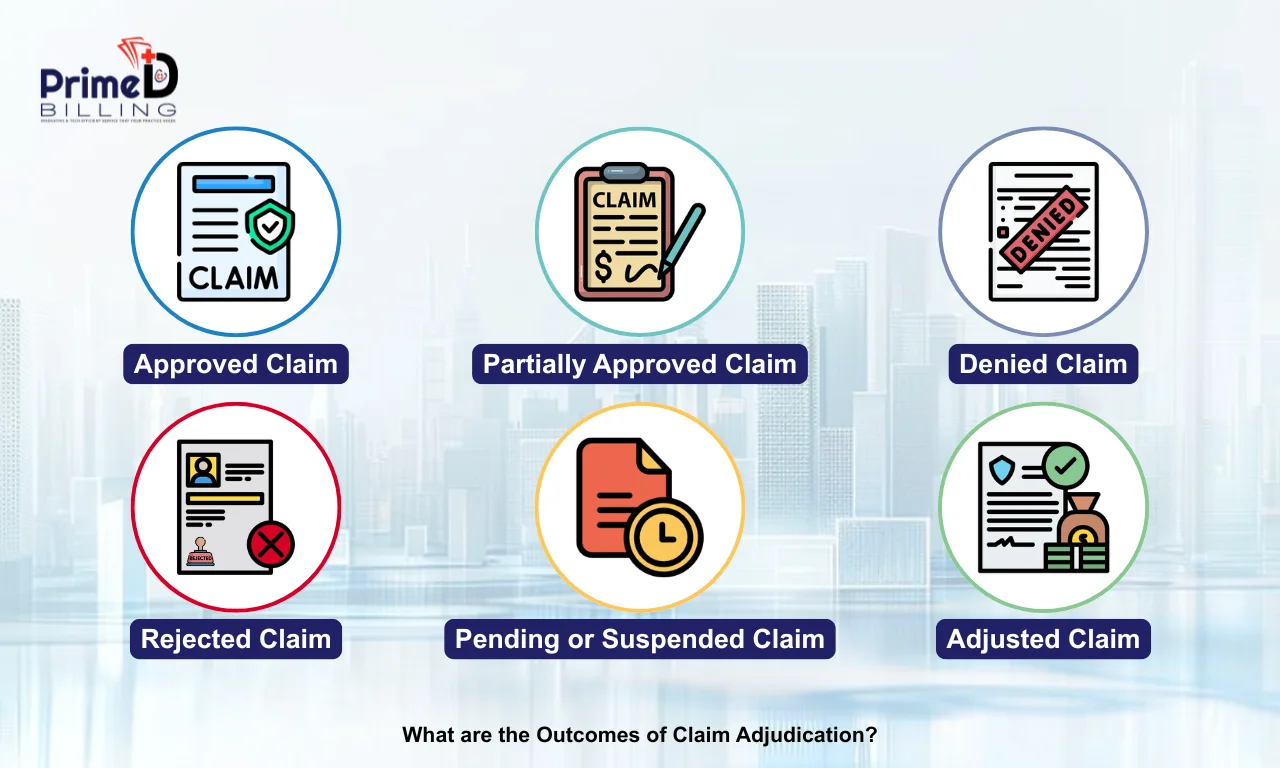
The medical claim often results in one of the following outcomes:
Approved Claim
A claim is approved when the insurance payer has accepted the claim for billed services after verifying the coverage and insurance policy requirements. The insurance payer then processes the claim for payment according to the patient’s benefits, contracted provider rates, deductibles, copayments, and coinsurance obligations.
Once the claim is processed, t he payer process the reimbursement for healthcare providers and states patient’s responsibility if any
Partially Approved Claim
In a partially approved claim, the insurer pays only for the services that qualify under the patient’s health plan while denying or reducing payments for other non-covered services. Partially approved claims are often a result of errors related to non-covered procedures, exceeded benefit limits, required prior authorization, or incorrect billing.
The provider usually bills the patient for remaining balances or sometimes submit an appeal to the insurers if necessary.
Denied Claim
When the claim is rejected for reimbursements, it is referred to as a denied claim. Common reasons for denial include lack of medical necessity, inactive insurance coverage, missing prior authorization, coding errors, duplicate billing, failure to meet payer’s requirements or billing services that are excluded from the patient’s policy.
Depending on the reason for denial, the provider either corrects the claim and resubmit it to the insurer or files an appeal with supporting documentation.
Rejected Claim
A rejected claim is returned before adjudication because of the technical or administrative errors that prevent claim processing. Some of the errors behind rejected claims include invalid patient information, incorrect provider identifiers, formatting issues, or missing required fields.
Healthcare providers typically correct the errors and resubmit the claim without going through the appeals process, since the claim was never fully reviewed by the insurer.
Pending or Suspended Claim
A pending or suspended claim requires additional review before making a final decision. The payer often requests medical records, and reports, proof of medical necessity, or other supporting documentation from the healthcare providers to verify the billed services.
Once the requested information is received and evaluated, the claim is either approved, partially approved, or denied.
Adjusted Claim
A claim is adjusted when the payer modifies the original reimbursement amount after adjudication. Adjustments are often a result of contractual payment agreements, coordination of benefits with another insurer, corrected coding, audit findings, or updated patient responsibility.
The insurance payer clearly reflects the revised payment in the Explanation of Benefits (EOB) or remittance advice issued to the provider.
How can Providers Improve Claim Acceptance during Adjudication?
Healthcare providers can improve claim acceptance during adjudication by strengthening their healthcare revenue cycle management processes, including:
- Verifying patient eligibility and benefits before services are rendered.
- Ensuring coding, charge capture, and documentation accurately support the services billed.
- Obtaining prior authorization when required by the payer.
- Using claim scrubbing and quality assurance processes to detect errors before claim submission.
These healthcare revenue cycle management best practices help create cleaner claims, reduce denials, and improve first-pass reimbursement rates.
Prime Doc Billing provides complete rcm solutions which can help you reduce denials, improve claim acceptance rate and accelerate reimbursement.
Frequently Asked Questions
How long does Claim Adjudication usually take?
The time required for the claim adjudication process depends on the claim type and complexity:
- Health Insurance Claims (7-30 days)
- Dental Insurance Claims (7-21 days)
- Workers’ Compensation Claims (2-8 weeks)
- Unemployment Claims (6-9 weeks)
- Government or Security Clearance Claims (60-90 days)
- Life Insurance Claims (14-60 days)
How does Claim Adjudication affect reimbursement?
Proper coding, documentation, and compliance ensure accurate and timely reimbursement for healthcare practices, while non-compliance issues often lead to denials or underpayments.
When is ERA generated during Claim Adjudication?
An Electronic Remittance Advice (ERA) is generated after the insurance payer finalizes the payment decision for healthcare providers. ERA provides healthcare providers with payment details, and adjustments codes for payment posting.
Does receiving an EOB mean the claim has been paid?
No, an EOB is not the payment confirmation itself. An EOB only summarizes the adjudication outcome and payment determination for healthcare providers.
What is the difference between claim rejection and denial?
Claim rejection occurs when the claim is not accepted for processing due to errors, while claim denial happens when the claim is processed but not paid after adjudication.
Can a denied claim be appealed after adjudication?
Yes, denied claims can be appealed after adjudication, depending on the payer’s guidelines and the reason for denial.
Partner with Prime Doc Billing Today
Let our experts handle your billing — streamline your revenue cycle and focus on patient care.

COB in Medical Billing: Definition, Importance, and Rules
August 7, 2026

Timely Filing Limits in Medical Billing
July 7, 2026

Healthcare EDI: Meaning, Transactions and Benefits
June 28, 2026